2

We have the functions $$f(x)= \log_2(x+3), \quad\text{ and }\quad g(x)= 1 + \log_{1/2}(x)$$

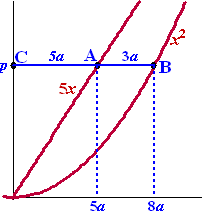
Find for which values of $q$ the graphs cut of a line segment of $2$ of the line $y=q$. (because of my poor English, here is a picture to illustrate what I mean rougly, don't look at the data, it just shows what I mean by 'cut of a line segment').

So what we basically have to solve:

$$f(p) = g(p+2) = q \vee g(p) = f(p+2) = q $$

When I try to solve this I run into this problem, I'll use $f(p) = g(p+2) = q$ as an example:

$$\log_2((p+3)(p+2)) = 1$$

The following step is made by the correction sheet, which I don't understand:

$$ (p+3)(p+2)=2$$

How did they simplify it like that? Also, does this mean we have to check the final answer of $p$ to insure if they're correct?

1 Answers1

1

They are just applying the definition of the logarithm: $$ \log_2 a=b \iff a=2^b. $$

So in this case, we have $\log_2\bigl((p+3)(p+2)\bigr)=1$; so, $$ (p+3)(p+2)=2^1=2. $$

The above quadratic has solutions $p=-4$ and $p=-1$. We do need to check these. But first, I'll point out that using the above definition is not the reason you have to check your proposed solutions. The reason is, rather, because in an earlier stage of the solution, when using the rules of logarithms, e.g. $\log(ab)=\log a+ \log b$, every term must be defined (and you could have $ab>0$ with $a<0$).

We see that only $p=-1$ gives a solution (for $p=-4$, neither $f(p)$, nor $g(p+2)$ is defined).

There is one other solution that can be obtained from your other equation.

David Mitra
  • 74,748