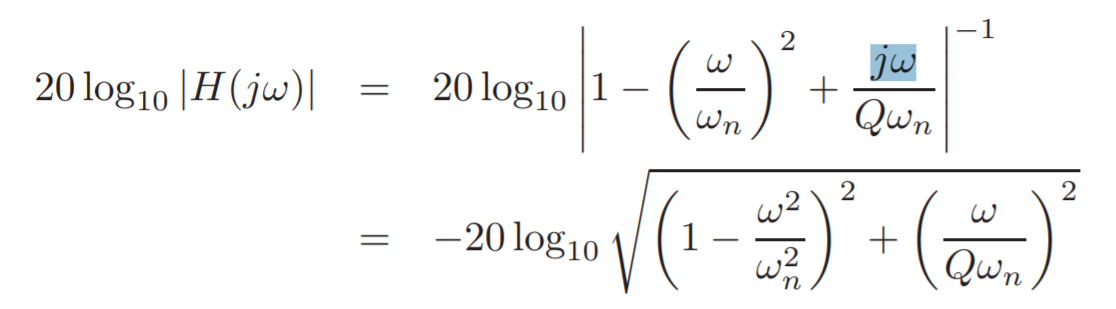
-1

I'm trying to learn how to do equations of filters for synthesizer design. I am stuck on this:

https://s15.postimg.cc/eiuti9fbv/image.png

How did they get from the equation with the jw to the one without the j in it?

ie. How did they get rid of the "j"?

I need to be able to do this for other equations. I don't even know what the "j" is though I do understand the rest. If I can understand this I should be able to make gain equations for all the filter types I need.

Thanks.

That equation comes from: http://www.kves.uniza.sk/kvesnew/dokumenty/DREP/Filters/SecondOrderFilters.pdf

Edit: Solved. Thanks guys.

Cave Johnson
  • 4,270
mike
  • 381
  • 1
  • 2
  • 14
  • It's just the absolute value of a complex number. – anomaly Jun 23 '18 at 03:00
  • As a start, you may think of complex number as a vector, so $j$ is a unit vector in the imaginary direction. Then the magnitude of $a+jb$ can be obtained by simply using the pythagaras theorem $$||a+\color{red}{j}b|| = \sqrt{a^2+b^2}$$ – AgentS Jun 23 '18 at 03:05
  • 1
    Note that what is often denoted by $j$ in electrical engineering and control system contexts is usually denoted by $\mathrm i$ in mathematics; see imaginary unit at Wikipedia. – joriki Jun 23 '18 at 03:43
  • 1
    Thanks guys. I didn't realize j = i. Now I can solve these equations fine. – mike Jun 23 '18 at 03:46
  • 1
    Crossposted from https://physics.stackexchange.com/q/413237/2451 – Qmechanic Jun 23 '18 at 04:03
  • 1
    Please don't crosspost, and especially don't crosspost without linking the two questions. You wasted a lot of people's time (including mine). – joriki Jun 23 '18 at 04:06

1 Answers1

0

Since my comment apparently answered the question, I'll post it as an answer so the question can be closed:

What is often denoted by $j$ in electrical engineering and control system contexts is usually denoted by $\mathrm i$ in mathematics; see imaginary unit at Wikipedia.

joriki
  • 238,052