This is slightly complicated because a lot of construction is necessary.
Produce PZ to cut BC produced at N. Produce PX to cut AC produced at U.
Through P, draw a line parallel to AB cutting BC at $B_1$, BD at B’, AE at A’ and AC at $A_2$.
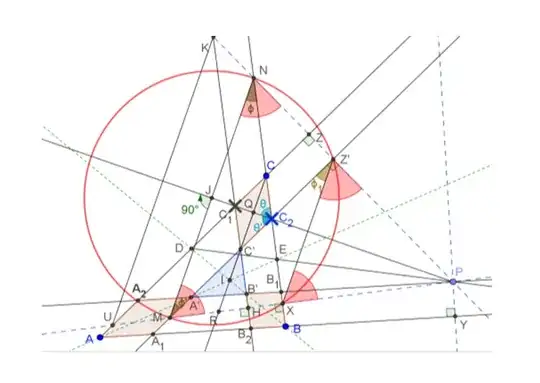
Through A’, draw a line parallel to AC cutting AB at $A_1$, PU at M, BC at $C_2$, and PN at Z’ (such that $\angle PZ’C_2 = 90^0$). After joining MN, we found that $C_2$ is the orthocenter of $\triangle PMN$ and therefore, $PC_2$ produced is perpendicular to MN at J.
Through B’, draw a line parallel to BC cutting AB at $B_2$, PU at H (such that $\angle UHB_2 = 90^0$), $A_1C_2$ at C’, and PZ produced at K. After joining UK, we found that $\triangle PUK$ has the orthocenter located at $C_1$.
Through the above construction, we have:-
(1) $AA_1A’A_2$, $BB_1B’B_2$, and $CC_1C’C_2$ are rhombuses;
(2) $\triangle A’B’C’$ is a miniature of $\triangle ABC$ with I serving as the in-centers for both triangles and therefore CC’I is a straight line (proof skipped) cutting PJ at Q and PM at R; and
(3) NMXZ’ is cyclic.
From (1), $\theta = \theta’$ implies $\phi = \phi’$ through congruence.
From (3), $\phi = \phi_1$. Then, MN // XZ’.
Further, all angles marked in red are equal. This means PX = PZ’.
Also from (1), since these rhombuses have equal altitudes, we have PY = … = ZZ’
Required result follows.


