We are given
$$x' = e^{x^2 -y^2} - 1 \\ y' = x^2y^{-1} + 2$$
Drawing the phase portrait (PP) is sometimes easy, but when the PP is complicated, we have to do a lot more analysis to figure out its true shape and that is the case here. Lets first do all the intermediate calculations. See the references below.
The critical points are given by
$$e^{\left(x^2-y^2\right)}-1=0,\dfrac{x^2}{y}+2=0 \implies (x, y) = (-2, -2), (2,-2)$$
The Jacobian matrix is given by
$$J_{(x,y)}(f)=\begin{pmatrix} \dfrac{\partial f_1}{\partial x} & \dfrac{\partial f_1}{\partial y} \\ \dfrac{\partial f_2}{\partial x} & \dfrac{\partial f_2}{\partial y} \end{pmatrix} = \begin{pmatrix}
2 e^{x^2-y^2} x & -2 e^{x^2-y^2} y \\
\dfrac{2 x}{y} & -\dfrac{x^2}{y^2} \\
\end{pmatrix}$$
The eigenvalues of the Jacobian at $(x, y) = (-2,-2)$ are
$$\lambda_{1,2} = \left\{\frac{1}{2} \left(-\sqrt{41}-5\right),\frac{1}{2} \left(\sqrt{41}-5\right)\right\} \implies \text{unstable saddle due to different signs} $$
The eigenvalues of the Jacobian at $(x, y) = (2,-2)$ are
$$\lambda_{1,2} = \left\{\frac{1}{2} \left(3+i \sqrt{7}\right),\frac{1}{2} \left(3-i \sqrt{7}\right)\right\} \implies \text{unstable spiral due to positive real part}$$
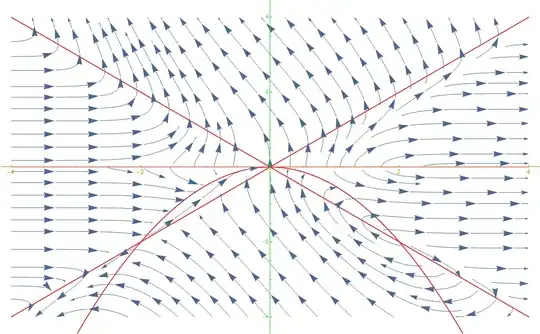
We now find the x-nullcline by solving for $y$ when $x' = 0$
$$x' = e^{x^2 -y^2} - 1 = 0 \implies y = \pm~ x$$
We now find the y-nullcline by solving for $y$ when $y' = 0$
$$x' = x^2y^{-1} + 2 = 0 \implies y = - \dfrac{x^2}{2}, ~ x \ne 0~\text{because we cannot divide by}~ y = 0$$
Along the nullclines the flow is either vertical $(x' = 0)$ or horizontal
$(y' = 0)$. They divide the phase plane into regions where the flow mainly points towards one of the four directions:
$$x' <0, y' < 0 ~ \text{or} ~ x' >0, y' < 0 \implies \text{down}$$
$$x' <0, y' > 0 ~ \text{or} ~x' >0, y' > 0 \implies \text{up}$$
The intersection points of the nullclines give the fixed points of the
flow. Since trajectories are not allowed to cross, the information given by
the nullclines often allows to make a qualitative plot of the dynamics.
You now select various $x$ and $y$ values and determine the up/down as prescribed above. Note that I also like to calculate $\dfrac{dy}{dx}$ in addition to the typical $x'$ and $y'$ values because I do not do these by hand and I like to know the magnitudes of the slopes. For example, varying $1 < x < 3$ and fixing $y = 0.5$, we generate a table of $\{x, y, \{y',x'\}, \dfrac{y'}{x'} = \dfrac{dy}{dx} \}$ as (compare these values to the PP and make sure you can do it by hand, for example, notice what is happening to the slope as we move towards $x = 3$)
$$\left(
\begin{array}{cccc}
1. & 0.5 & \{4.,1.117\} & 3.58102 \\
1.1 & 0.5 & \{4.42,1.6117\} & 2.74245 \\
1.2 & 0.5 & \{4.88,2.28708\} & 2.13372 \\
1.3 & 0.5 & \{5.38,3.2207\} & 1.67045 \\
1.4 & 0.5 & \{5.92,4.52896\} & 1.30714 \\
1.5 & 0.5 & \{6.5,6.38906\} & 1.01736 \\
1.6 & 0.5 & \{7.12,9.07442\} & 0.784623 \\
1.7 & 0.5 & \{7.78,13.0132\} & 0.597854 \\
1.8 & 0.5 & \{8.48,18.8857\} & 0.449017 \\
1.9 & 0.5 & \{9.22,27.7892\} & 0.331784 \\
2. & 0.5 & \{10.,41.5211\} & 0.240842 \\
2.1 & 0.5 & \{10.82,63.0715\} & 0.171551 \\
2.2 & 0.5 & \{11.68,97.4944\} & 0.119802 \\
2.3 & 0.5 & \{12.58,153.47\} & 0.0819704 \\
2.4 & 0.5 & \{13.52,246.151\} & 0.0549256 \\
2.5 & 0.5 & \{14.5,402.429\} & 0.0360312 \\
2.6 & 0.5 & \{15.52,670.826\} & 0.0231356 \\
2.7 & 0.5 & \{16.58,1140.39\} & 0.0145389 \\
2.8 & 0.5 & \{17.68,1977.31\} & 0.00894142 \\
2.9 & 0.5 & \{18.82,3497.19\} & 0.00538147 \\
3. & 0.5 & \{20.,6309.69\} & 0.00316973 \\
\end{array}
\right)$$
Using all of this information (please fill in the blanks), we can start to draw the PP and here is a computer generated one (note the behavior for $y = 0$ (because it is a nullcline) of the phase portrait).
References:
How to draw a phase portrait of a two-dimensional ODE?
https://www.math.unl.edu/~mbrittenham2/classwk/221f09/handouts/linsys.pdf
https://mcb.berkeley.edu/courses/mcb137/exercises/Nullclines.pdf
http://www.math.ubc.ca/~israel/m215/nonlin/nonlin.html
https://ocw.mit.edu/courses/mathematics/18-03sc-differential-equations-fall-2011/unit-iv-first-order-systems/qualitative-behavior-phase-portraits/
http://fy.chalmers.se/~f99krgu/dynsys/DynSysLecture4.pdf
http://tutorial.math.lamar.edu/Classes/DE/PhasePlane.aspx


