1

Condition

Attempt:

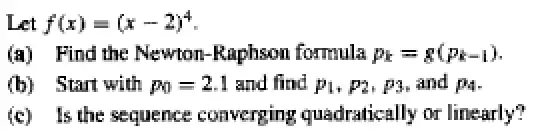
a) $g(x) = x- f(x)/f’(x) = x – [(x-2)^4]/[4(x-2)^3] = (2-x)/4+x = (3x+2)/4$

So, $p_k = [3p_{k-1}+2] /4$

b)

p(1)=2.1; for j=2:5, p(j) = (3*p(j-1)+2)/4 end

p = 2.1000 2.0750 2.0563 2.0422 2.0316

So, p(0)=1

p(1)=2.0750

p(2)=2.0563

p(3)=2.0422

p(4)=2.0316

c) Tried this:

for i=1:4 p(i+1)-p(i) end

ans = -0.0250

ans = -0.0187

ans = -0.0141

ans = -0.0105

So, p(1)-p(0) = -0.0250

p(2)-p(1)= -0.0187

p(3)-p(2)= -0.0141

p(4)-p(3) = -0.0105

What next?

John Lennon
  • 1,302

2 Answers2

1

The equation $(x-2)^4=0$ has the obvious root $x=2$.

We have $$p_{n+1}-2=\frac{3p_n+2}{4}-2=\frac{3}{4}(p_n-2).$$ Thus $$|p_{n+1}-2|=\frac{3}{4}|p_n-2|.$$

So the distance from the root is multiplied by the factor $\frac{3}{4}$ for each iteration. This is linear convergence.

Remark: Note that the behaviour of the Newton Method in this case is worse than the behaviour of the Bisection Method.

The reason for the bad behaviour is that the derivative of our function $(x-2)^4$ is $0$ at the root.

André Nicolas
  • 507,029
1

Given the recurrence you have derived, it is apparent that

$$p_n = 2 + \left ( \frac{3}{4} \right )^n (p_1 - 2)$$

so that

$$p_{n+1}-p_n = \frac{3}{4} (p_n-p_{n-1})$$

Your recurrence converges to the root $x=2$ linearly.

Ron Gordon
  • 138,521