0

This is probably a really bad question with some major oversights, but I don't seem to see them right now.

If I define a function $$ z = f(x,y) = x^2 + y^2$$ and took the partial derivative respect to $z$ of $z$ and $f(x,y)$ is it correct to say:

\begin{align} \frac{\partial z}{\partial z} &= \frac{\partial f(x,y)}{\partial z} \\ 1 &= 2x\frac{\partial x}{\partial z} + 2y\frac{\partial y}{\partial z} \ ? \end{align}

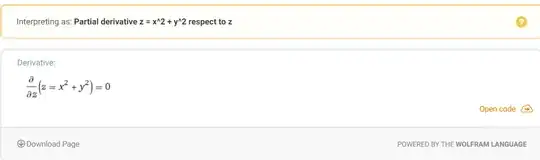
I tried Wolfram Alpha but it gave me this instead.

Screenshot of Wolfram Alpha

Following the chain rule I get the same answer.

Rócherz
  • 3,976
Nick Yarn
  • 61
  • 8
  • Neither the question nor the accepted answer makes any sense. – Christian Blatter Nov 08 '18 at 09:30
  • Notation? Or just in general. – Nick Yarn Nov 08 '18 at 13:51
  • One only can take partial derivatives when a certain set of variables has been declared and agreed as independent. In the case at hand these are the variables $x$ and $y$. It is only allowed to take partial derivatives with respect to these two. You don't even know what kind of information the "partial derivative of whatever with respect to $z$" should convey. – Christian Blatter Nov 08 '18 at 14:14
  • Right, so I guess my question should have been is there a multivariable equivalent to single variable implicit differentiation. The YouTuber 3blue1one brown did something similar. 3 variables of which 2 are independent and 1 dependent. https://www.google.com/url?sa=t&source=web&rct=j&url=%23&ved=2ahUKEwizk5mFgMXeAhUq1VkKHTu0B30Q8TUwAHoECAkQAw&usg=AOvVaw0VTJzWxrN8ZFOD4xbU2nov – Nick Yarn Nov 08 '18 at 14:26

1 Answers1

0

Woflram outputs this result because it assumes x and y don't depend on z, which means it finds that:

$\frac{\partial x}{\partial z} = 0, \frac{\partial y}{\partial z} = 0$

But yes, you can technically say:

$1=2x \frac{\partial x}{\partial z}+2y \frac{\partial y}{\partial z}$

Although it's rather meaningless. You're expecting the partials of x and y with respect to z to yield "something else", but x and y DO depend on z by:

$z=x^2 + y^2$

We can explicitly show it by:

$x=\sqrt{z-y^2}$ and $y=\sqrt{z-x^2}$

Then using the Chain Rule:

$\frac{\partial x}{\partial z} =\frac{1}{2 \sqrt{z-y^2}}(1-2y\frac{\partial y}{\partial z})=\frac{1}{2x}(1-2y\frac{\partial y}{\partial z})$ and $\frac{\partial y}{\partial z} =\frac{1}{2 \sqrt{z-x^2}}(1-2x\frac{\partial x}{\partial z})=\frac{1}{2y}(1-2x\frac{\partial x}{\partial z})$

Plugging them into each other:

$\frac{\partial x}{\partial z} =\frac{1}{2x}(1-2y(\frac{1}{2y}(1-2x\frac{\partial x}{\partial z})))=\frac{1}{2x}(2x\frac{\partial x}{\partial z})=\frac{\partial x}{\partial z}$

$\frac{\partial y}{\partial z} =\frac{1}{2y}(1-2x(\frac{1}{2x}(1-2y\frac{\partial y}{\partial z})))=\frac{1}{2y}(2y\frac{\partial y}{\partial z})=\frac{\partial y}{\partial z}$

And we come to a roundabout answer.
Andrew
  • 356
  • Thanks for the clarification. – Nick Yarn Nov 08 '18 at 04:27
  • Would it be wrong though if I took the partial derivative of z respect to x and got this dz/dx = 2x + 2y (dy/dx) (assume d = partial sign) and said dy/dx is zero – Nick Yarn Nov 08 '18 at 04:29
  • Pardon me I havn't taken calc 3 in a while – Nick Yarn Nov 08 '18 at 04:30
  • If you know that y is not a function of x, then yes dy/dx would be 0, and then dz/dx=2x. But you would have to know if there was another relationship for y to get dy/dx=0. – Andrew Nov 08 '18 at 04:40
  • Can't f(x,y) and x have a relationship with y. Like y = sqrt(z - y^2)? – Nick Yarn Nov 08 '18 at 04:46
  • To get the two square-root functions I wrote before, I just inverted z=x^2+y^2 for both x and y. But to get something like y=sqrt(z-y^2), you'd need to know that a relationship of the form z=2y^2 also exists. Is this for a homework problem? – Andrew Nov 08 '18 at 04:57
  • No, I just wanted to review Calc 1,2,3 – Nick Yarn Nov 08 '18 at 05:12
  • I made up that question. I'm trying to understand the divergence theorem but to do that I needed to learn normal vectors of a surface which lead me to gradients then to partial derivatives. – Nick Yarn Nov 08 '18 at 05:13
  • So for a surface z = f(x,y) to find the normal vector we define F(x,y,z) = f(x,y) - z. Knowing that the gradient is always orthogonal to the level curve 0 = f(x,y) - z, we take the gradient of F(x,y,z) and for (x,y,z) on the surface the grad(F(x,y,z) will be the normal vector at that point. However, taking the gradient threw me off since the f(x,y) = z I thought the partial of f(x,y) respect to z equaled the partial of z respect to z. Anyways I'll be posting another question on this. – Nick Yarn Nov 08 '18 at 05:17