3

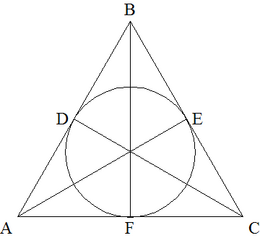
Let $T_1$ be a triangle with sides $2011, 2012,$ and $2013$. For $n \ge 1$, if $T_n = \triangle ABC$ and $D, E,$ and $F$ are the points of tangency of the incircle of $\triangle ABC$ to the sides $AB, BC$ and $AC,$ respectively, then $T_{n+1}$ is a triangle with side lengths $AD, BE,$ and $CF,$ if it exists. What is the perimeter of the last triangle in the sequence $( T_n )$?


Here is the diagram: https://wiki-images.artofproblemsolving.com//thumb/e/e4/File2011AMC10B25.png/260px-File2011AMC10B25.png

Anyways So it appears to me that it is a infinite sequence. After all, for what I understand it, it seems to want me to draw a circle inscribed in the ABC triangle, take the 3 sides it gives, and construct another triangle, in which you repeat the process until no such triangle exists. However, I believe that there always will be a triangle that can be constructed, there is just no way that the three smaller sides of a triangle can't be constructed into another. Where is the flaw in my logic? Thanks! Max0815

Max0815
  • 3,505
  • 1
    Why do you believe so? As long as the new sides don't satisfy the triangle inequality, we cannot construct a triangle anymore. – Eclipse Sun Jan 28 '19 at 04:30
  • How come? We cut off a little more than half each time. The side ratios stay the same... – Max0815 Jan 28 '19 at 04:31
  • It is not hard to compute the side ratio of $T_2$, which turns out to be different from that of $T_1$. I don't know why it is obvious to you the ratios will stay the same. – Eclipse Sun Jan 28 '19 at 04:35
  • Oh shoot. I see. Thanks for the hint. I'll take some time and try to do some casework until somebody fills me an idea of a faster way. Other than that, lol I'll be on my own finding the pattern here. Thanks BTW. – Max0815 Jan 28 '19 at 04:39
  • Here is a supplementary question: The incircle of $\triangle ABC$ touches $BC$ at $P$, $CA$ at $Q$ and $AB$ at $R$. Prove $AP$, $BQ$ and $CR$ form a triangle. – Anubhab Jan 28 '19 at 13:54
  • @AnubhabGhosal That is not true in a general case. – Saša Jan 28 '19 at 19:48
  • 1
    The ratio does not stay the same. – Saša Jan 28 '19 at 19:49
  • @Oldboy Yeah I saw – Max0815 Jan 29 '19 at 02:41
  • @Oldboy, I have a proof. If triangle inequality is satisfied by $AB,\ BC$ and $CA$, it is also satisfied by $AP,\ BQ$ and $CR$. – Anubhab Jan 29 '19 at 03:48

1 Answers1

1

If you start with:

$$AD+BE=c, \ BE+CF=a, \ CF+AD=b$$

you get the following:

$$AD=\frac12(b+c-a)\tag{1}$$

$$BE=\frac12(c+a-b)\tag{2}$$

$$CF=\frac12(a+b-c)\tag{3}$$

Let $a$ be the length of the shortest side:

$$a_1=2011,\ b_1=a_1+1, \ c_1=a_1+2$$

By applying (1),(2),(3) you get:

$$AD=\frac12(a_1+3)=\frac {a_1-1}2+2$$

$$BE=\frac12(a_1+1)=\frac {a_1-1}2+1$$

$$CF=\frac12(a_1-1)=\frac {a_1-1}2$$

So in the next iteration we'll have:

$$a_2=\frac{a_1-1}2, \ b_2=a_2+1, \ c_2=a_2+2$$

The point is: we still have an arithmetic progression with the same difference (+1). So you can quickly proceeed from one triangle to the next one just by calculating the shortest side in the next iteration with a fairly simple formula:

$$a_{n+1}=\frac{a_n-1}{2}\tag{4}$$

The other two sides are simply:

$$b_{n+1}=a_{n+1}+1, \ c_{n+1}=a_{n+1}+2$$

How far can we go down the road? As long as:

$$a_n+b_n>c_n\implies a_n+a_n+1>a_n+2\implies a_n>1$$

So we have to stop with iterations when $a_n$ becomes less than or equal to 1.

By using (4), we can now calculate the sequence which represents the length of the shortest triangle side $a_i$:

$$2011, \ 1005, \ 502.0, \ 250.5, \ 124.75, \\ 61.875, \ 30.4375, \ 14.71875, \ 6.859375, \ 2.9296875$$

The next value would be less than 1 so we have to stop here. The last triangle has the following side lengths:

$$a_{10}=2.9296875, \ \ b_{10}=3.9296875, \ \ c_{10}=4.9296875$$

...with circumference equal to $11.7890625$.

Saša
  • 15,906