Let us introduce a simplified system of letters on the following figure:
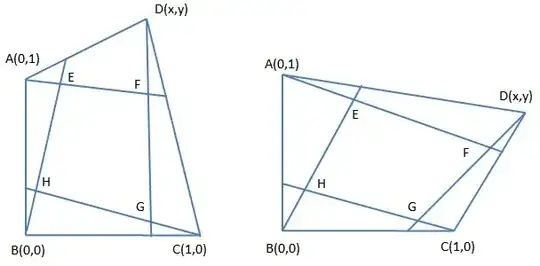
Fig. 1 : See explanations below for the coordinates of $A,B,C,D$. The figure on the right illustrates a somewhat non-intuitive fact : taking a point $D$ symmetrical to its initial position (figure on the left) vs. line bissector $y=x$ gives rise to a quadrilateral $ABCD$ keeping, evidently, the same area, but to an interior quadrilateral $EFGH$ which isn't an isometric image of the initial $EFGH$, therefore with a different area in general.
Let $$r:=\dfrac{Area_{EHGF}}{Area_{ABCD}}$$
Alas, the result
$$r=\frac{2}{5}$$
is false in general (see below).
This paradox has been well underlined for a very similar case in the following reference :
"Fooled by rounding" and the connected one where the "original sin" is to consider only quadrilaterals that are trapezoidal or close to be trapezoids.
In order to have a global view, let us fix 3 of the four points :
$$A=(0,1), \ \ B=(0,0), \ \ C=(1,0)$$
and let $D=(x,y)$ vary in the domain defined by $x+y \geq 1$ (in order that quadrilateral $ABCD$ is convex). The important thing is that we can do this WLOG because being given any quadrilateral, there exists an affine map that "sending" this quadrilateral to a particular quadrilateral where $ABC$ is a right isosceles triangle, with preservation of the ratio of areas (because the ratio of areas is an affine invariant (see slide 5 of this good classification).
Here is (Fig. 2) a graphical representation of function $(x,y) \mapsto r(x,y)$ as a surface with its level lines.
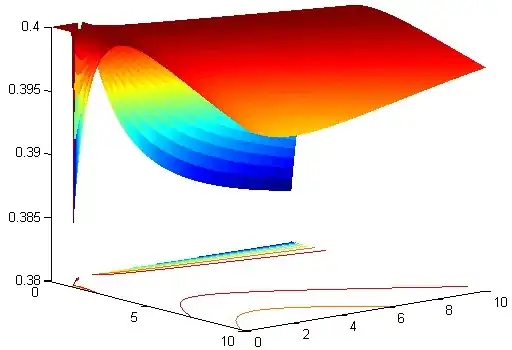
Fig. 2 : Representation of $r=r(x,y)$ as a surface with some of its level lines.[The tiny triangular region one finds on the left, for which $x+y<1$ isn't significant : $D$ cannot be there]. There is a "notorious" point $S=(1,1,0.4)$ featuring the case where $ABCD$ is a square (in fact all rectangles are mapped to this point as well). It is not the only point with altitude $1$ ; in fact, there is line crest of points sharing with $S$ the altitude 0.4. Another special position is $D=(0.5,0.5)$ where $r=19/48=0.3958...$ (case where $A,D,C$ aligned). The range of values of $r$ looks bounded from below with a least upper bound around $0.38$ (on an experimental basis). See Fig. 3 for an explicit calculation.
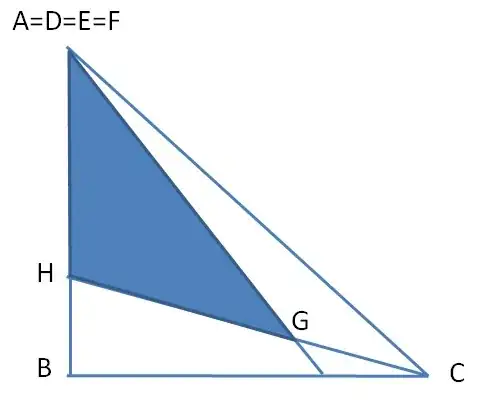
Fig. 3 : An explicit calculation of $r$ in a "coalescence" case : $D$ coincides with $A$ ; therefore $E$ and $F$ coincide with them. In this case, it is not difficult to show that $r=\frac{8}{21}\approx 0.381$ (using the fact that the abscissa of $G$ is $4/7$).


