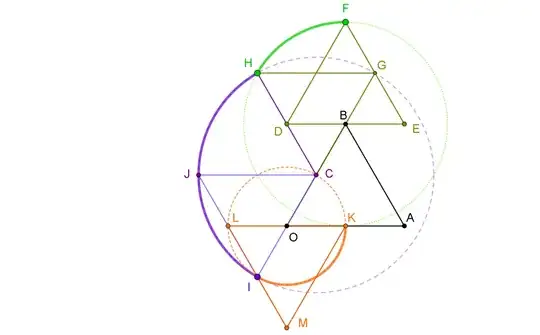
We have $6$ rotations through $\frac{2\pi}3$ each, $3$ about the corners of the moving plate and $3$ about its midpoints. In each such rotation, a given corner is rotated through an arc of length $\frac{2\pi}3\cdot d$, where $d$ is the distance of the corner from the centre of rotation.
If we assume that the diagram is meant to imply that the corners are always on the midpoints of the sides, the total distance travelled is
$$
\frac{2\pi}3\left(0+\frac a2+a+\frac{\sqrt3}2a+a+\frac a2\right)=2\pi a\left(1+\frac{\sqrt3}6\right)\;.
$$
For the general case, assume that when a corner lies on a side, its distance from the nearest corner of the other triangle is $x\le\frac a2$. Then the total distance travelled is
$$
\frac{2\pi}3\left(0+d+a+\sqrt{\left(\frac a2-d\right)^2+\frac34a^2}+a+(a-d)\right)=2\pi a\left(1+\frac13\sqrt{1-\frac da+\left(\frac da\right)^2}\right)\;,
$$
which is minimal for $d=\frac12$, the case above, and maximal for $d=0$, in which case it’s $\frac{8\pi a}3$ (and you can check that that’s the result you get if you just rotate about each of the $3$ corners through $\frac{4\pi}3$.