0

m

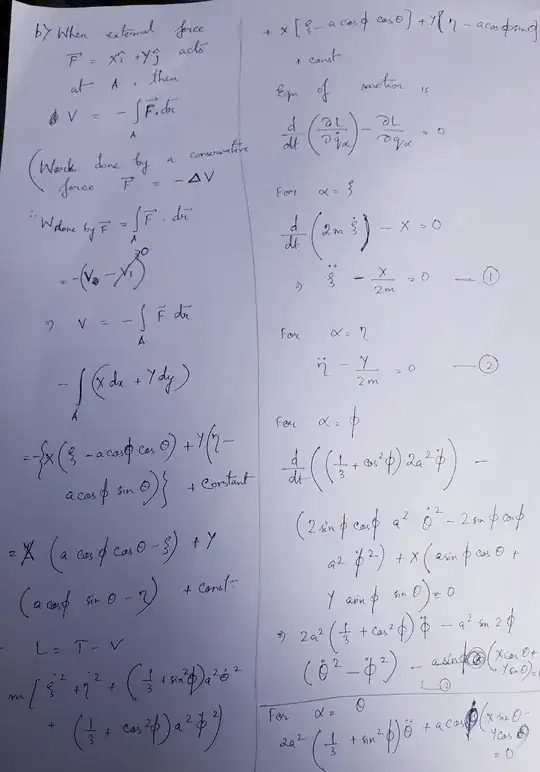
For the above question I have proceeded in following way:

enter image description here

However I am unable to proceed and am unable to use $\theta$ in any further equation. I think I am getting the concept wrong somewhere.

For the second part I have proceeded in the following way: Is the approach correct?

enter image description here

Sharmi C
  • 419

1 Answers1

1

For the kinetic energy calculation. Calling

$$ \cases{ p_g = (\xi, \eta)\\ \vec n = (\sin\theta,-\cos\theta)\\ p_1 = p_g+a\sin\phi\vec n\\ p_2 = p_g-a\sin\phi\vec n\\ } $$

Decomposing the kinetic energy into rotational plus translational we have

$$ T = \frac 12 L\left((\dot \theta+\dot \phi)^2+(\dot \theta-\dot\phi)^2\right)+\frac m2 \dot p_1^2 + \frac m2 \dot p_2^2 $$

Here $L = \frac {1}{12}m(2a)^2$ and $p_1,p_2$ are the mass center for the two rods respectively.

$$ T = m \left(\dot \xi^2+\dot\eta^2+a^2 \left(\cos ^2(\phi)+\frac{1}{3}\right) \dot\phi^2+a^2 \left(\sin ^2(\phi)+\frac{1}{3}\right) \dot\theta^2\right) $$

Cesareo
  • 33,252
  • Is the angle AED = $\theta$ ? If yes, Why? – Sharmi C Mar 30 '20 at 16:45
  • 1
    Note that the $\theta$ direction can be represented by the unit vector $(\cos\theta,\sin\theta)$ and $\vec n = (\sin\theta,-\cos\theta)$ is also an unit vector orthogonal to the $\theta $ direction as needed to locate from $(\xi,\eta)$ the points $D, E$ – Cesareo Mar 30 '20 at 16:51
  • But shouldn't $\vec n = (-\sin\theta, \cos\theta)$ if $\vec n$ is from P towards D ? – Sharmi C Mar 30 '20 at 19:29
  • Due to the symmetry of $D,E$ regarding $(\xi,\eta)$ it doesn't matter. – Cesareo Mar 30 '20 at 19:33