That is, how to prove the following identity: $$a \times (b+c) = a \times b + a \times c$$ where the $\times$ represents cross product of two vectors in 3-dimensional Euclidean space.
Asked
Active
Viewed 5.6k times

6 Answers
28
To see it geometrically:
Recall that $\lVert x\times y\rVert$ represents the area of the parallelogram with sides $x,y$. If you then "glue" together the parallelograms with sides $a,b$ and $a,c$ along the side $a$, you get a hexagon (not regular) with the same area of the parallelogram with sides $a,b+c$.
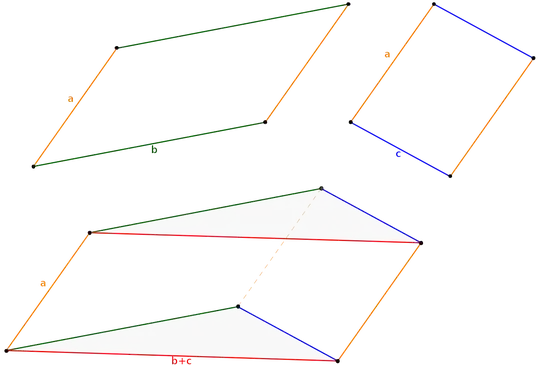
Edit: As another user correctly noted, the above proof works only when $a$ lies in the plane spanned by $b$ and $c$. If not, then we can reduce to this case by considering the triangle $T$ with base $b+c$ and sides $b,c$, as suggested by this image1:

Indeed, without loss of generality we may assume that $a$ is orthogonal to $b$ and $c$. Then the angle and proportion between $a \times b$ and $a \times c$ are the same as those between $b$ and $c$, because in this case the cross product with $a$ is equivalent to the composition of a rotation by $90$ degrees and a dilation by $\lVert a \rVert$. Therefore if $P$ is the prism with base $T$ and height $a$, then the area of the projection of the face $[a,b]$ on the face $[a,b+c]$ is the same as the length of the cross product between $a$ and the projection of $b$ on $b+c$, and similarly for the face $[a,c]$.
1. Courtesy of WikiMedia.


-
I added a descriptive image. – A.P. Apr 15 '13 at 17:12
-
2Could whoever downvoted this explain why they did so, allowing me to improve my answer? – A.P. Apr 05 '15 at 12:26
-
3Your answer assumes that $a$, $b$ and $c$ all lie in the same plane. When they don't, which they don't in general, it breaks down. – Christopher Apr 07 '15 at 12:51
-
($a \times b$ and $a \times c$ are no longer parallel, so the magnitude of their sum is less than the sum of their magnitudes; the picture at the bottom fails because it's now depicting a 3-d solid rather than a planar shape.) – Christopher Apr 07 '15 at 12:53
-
2@user73985 thanks for catching the omission. I amended my answer and it should be fine now. – A.P. Apr 10 '15 at 19:28
-
This answer seems to show only that the magnitude of LHS = magnitude of RHS. Does it show that LHS and RHS are both vectors pointing in the same direction? – Apr 02 '16 at 04:52
-
2Why can you assume that a is orthogonal to b and c? – Gavin Smith Jan 08 '18 at 20:56
-
The prism picture is plain wrong. If area(B) = a x b, area(C) = a x c and area(B+C) = a x ( b + c), there's no way that area(B) + area(C) = area(B+C). Not to mention that it doesn't prove anything about the resulting vector directions. I've never down-voted an answer before but this wasted half an hour of my life. @Srivatsa points to the correct proof. – PJ_Finnegan Oct 24 '19 at 19:25
-
@PJ_Finnegan If you read carefully, I am not saying that $\operatorname{area}(B) + \operatorname{area}(C) = \operatorname{area}(B+C)$, but rather that $\operatorname{area}(\operatorname{proj}(B)) + \operatorname{area}(\operatorname{proj}(C)) = \operatorname{area}(B+C)$, where $B$, $C$ and $B+C$ denote faces of the prism (not vectors), and where $\operatorname{proj}$ denotes the projection of a face onto the plane spanned by $a$ and $c$. It is perfectly fine to say that you disagree with what I (or anybody else) wrote, but please try not to be rude next time. – A.P. Oct 25 '19 at 09:13
-
@A.P. the area relationships are implicit in the picture, since the prism faces are the parallelograms spanned by $a \times b, a \times c, a \times (b+c)$, and the sum of their areas should be equal as per the identity to be proved. You asked why people was down-voting and I gave my honest opinion, sorry if I came across a little pissed for this answer confusing at best, I guess I should take it out on who up-voted it. – PJ_Finnegan Oct 25 '19 at 20:02
-
I cannot see how this approach can work in the case of an oblique prism, where $\mathbf b$ and $\mathbf c$ undergo different rotations under $x \times \mathbf{a}$. – Papa Smurf Mar 01 '23 at 10:41
13
Just to enrich the post for future readers, I would like to add another derivation that I found on the internet. This proof uses the distributivity of the dot product (which is easier to prove), and the property that the circular commutation of vectors doesn't change the triple product of the vectors (which is quite obvious, since the triple product is just the volume of the parallelepiped formed by the vectors).
Let $d = a \times (b + c) - a \times b - a \times c$
so it is required to prove that $d = 0$:
$d^2$ = $d \cdot d$
$= d \cdot (a \times (b + c) - a \times b - a \times c)$
$= d \cdot (a \times (b + c)) - d \cdot (a \times b) - d \cdot (a \times c)$
$= (d \times a) \cdot (b + c) - (d \times a) \cdot b - (d \times a) \cdot c$
$= (d \times a) \cdot (b + c) - (d \times a) \cdot (b + c)$
$= 0$
Therefore $d = 0$, so $a \times (b + c) = a \times b + a \times c$.

Sidd
- 835
-
4I think you need to add a bit more work for this proof to be convincing. Namely, prove that (i) the triple product is the volume of the parallelepiped; and (ii) the triple product is circularly commutative without relying on the distributivity of the cross product. Otherwise one wonders if these latter two facts somehow depend on the fact that the cross product is distributive. (I know they don't, but there is this gap in your answer.) – Apr 22 '16 at 05:15
4
Let $a=(a_1,a_2,a_3),~~b=(b_1,b_2,b_3),~~c=(c_1,c_2,c_3)\in\mathbb R^3$ so $$a\times(b+c)=\begin{vmatrix} i\;\;\;j\;\;\;k \\ a_1\;\;\;a_2\;\;\;a_3 \\ b_1+c_1\;\;\;b_2+c_2\;\;\;b_3+c_3 \end{vmatrix}=i\left(a_2b_3+a_2c_3-a_3b_2-a_3c_2\right)-j(...)+k(...)$$ Now try to rearrange the above terms to find the result. See that in the first term we have $i\left(a_2b_3+a_2c_3-a_3b_2-a_3c_2\right)=i(a_2b_3-a_3b_2)+i(a_2c_3-a_3c_2)$.

Mikasa
- 67,374
-
7
-
@Berci: As you commented before, I don't know what the OP know and how he/she wanted to do the problem. – Mikasa Apr 15 '13 at 09:27
-
2Doesn't this expression (as a determinant) for the cross product of two vectors itself require distributivity of the cross product? – Shinsekai no Kami Apr 22 '18 at 10:47
3
Thought I'd share my geometric proof. Even though it in essence doesn't differ much from the one linked to by @Srivatsa, I've tried to add some more clarity through descriptive diagrams.
The geometric definition of the cross product of two vectors $\mathbf{A}$ and $\mathbf{B}$ is given by $$\mathbf{A} \times \mathbf{B} \overset{\operatorname{def}}{=} |\mathbf{A}||\mathbf{B}|\sin \theta \,\hat{\mathbf{N}},$$ where $\theta \in [0,\pi]$ is the angle between the two vectors when placed tail to tail, and $\hat{\mathbf{N}}$ is a unit vector whose orientation is determined by the right-hand rule. We are to prove that $$\mathbf{C} \times (\mathbf{A} + \mathbf{B}) = \mathbf{C} \times \mathbf{A} + \mathbf{C} \times \mathbf{B}.$$ To do this, first consider some arbitrary plane in $\mathbb{R}^3$ with unit normal vector $\hat{\mathbf{n}}$, as seen below.

We can always place the tails of two vectors $\mathbf{A}$ and $\mathbf{B}$ onto this plane as vectors (their magnitude and orientation) stay the same no matter where in space they reside. Now let’s establish two important facts.

Define $\mathbf{P}(\mathbf{A})$ as the orthogonal vector projection of $\mathbf{A}$ onto the plane. From the figure above and the right-hand rule we see that that $\hat{\mathbf{n}} \times \mathbf{A}$ and $\hat{\mathbf{n}} \times \mathbf{P}(\mathbf{A})$ have the same orientation. Moreover, they also have the same magnitude;
$$ |\hat{\mathbf{n}} \times\mathbf{A}| = |\hat{\mathbf{n}}||\mathbf{A}|\sin \alpha = |\hat{\mathbf{n}}||\mathbf{P}(\mathbf{A})| \sin \frac{\pi}{2} = |\hat{\mathbf{n}} \times \mathbf{P}(\mathbf{A})|. $$
Thus, we have that
$$ \hat{\mathbf{n}} \times \mathbf{A} = \hat{\mathbf{n}} \times \mathbf{P}(\mathbf{A}) \tag{1} $$
and a similar argument of course applies to $\mathbf{B}$ (or any other vector).
 Furthermore, from the figure above we can recognize that the projection operation is linear;
$$ \mathbf{P}(\mathbf{A} + \mathbf{B}) = \mathbf{P}(\mathbf{A}) + \mathbf{P}(\mathbf{B}) \tag{2}. $$
These two properties allows us to work with projections rather than the vectors themselves, which simplifies things considerably.
Furthermore, from the figure above we can recognize that the projection operation is linear;
$$ \mathbf{P}(\mathbf{A} + \mathbf{B}) = \mathbf{P}(\mathbf{A}) + \mathbf{P}(\mathbf{B}) \tag{2}. $$
These two properties allows us to work with projections rather than the vectors themselves, which simplifies things considerably.

In this last figure we can study the projections of all relevant vectors and see that $$ \hat{\mathbf{n}} \times \big(\mathbf{P}(\mathbf{A}) + \mathbf{P}(\mathbf{B})\big) = \hat{\mathbf{n}} \times \mathbf{P}(\mathbf{A}) + \hat{\mathbf{n}} \times \mathbf{P}(\mathbf{B}) $$ since taking the cross product with $\hat{\mathbf{n}}$ and a vector projection effectively rotates the projection $\pi/2$ radians counterclockwise about $\hat{\mathbf{n}}$ without changing its magnitude. We now use the linearity of projections $(2)$ to rewrite the left-hand side $$ \hat{\mathbf{n}} \times\mathbf{P}(\mathbf{A}+ \mathbf{B}) = \hat{\mathbf{n}} \times \mathbf{P}(\mathbf{A}) + \hat{\mathbf{n}} \times \mathbf{P}(\mathbf{B}) $$ and property $(1)$ gives us $$ \hat{\mathbf{n}} \times (\mathbf{A}+ \mathbf{B}) = \hat{\mathbf{n}} \times \mathbf{A} + \hat{\mathbf{n}} \times \mathbf{B}. $$ We can muliply both sides by a scalar $C$ and set $\mathbf{C} = C\hat{\mathbf{n}}$ (remember, the orientation of the plane and thereby that of $\hat{\mathbf{n}}$ and $\mathbf{C}$ is arbitrary) to finally arrive at $$ \mathbf{C} \times (\mathbf{A} + \mathbf{B}) = \mathbf{C} \times \mathbf{A} + \mathbf{C} \times \mathbf{B}, $$ Q.E.D.
We can from here easily use the antisymmetric property of the cross product to also prove that $$ (\mathbf{A} + \mathbf{B}) \times \mathbf{C} = \mathbf{A} \times \mathbf{C} + \mathbf{B} \times \mathbf{C}. $$

Engelmark
- 123
2
Found a geometric proof in https://en.wikiversity.org/wiki/Cross_product. Refer to section: Equivalence of the two Definitions

Srivatsa
- 37
-
2The question has already an accepted answer. I'm not sure your answer is highly useful, in my opinion. – Watson Feb 04 '16 at 13:29
-
This. The proof is straightforward if you project a and b onto the plane P orthogonal to c. – PJ_Finnegan Oct 24 '19 at 19:17
-
2
1
Here's a geometric proof in the same vein as those by Srivatsa and Engelmark.
Notation: in the context of a cross product $\vec a\times\vec b$ we write $\vec a_\perp$ for the component of $\vec a$ perpendicular to $\vec b$.
From the definition of the cross product it is clear that $\vec a\times\vec b = \vec a_\perp\times\vec b$ (for example if $\vec a\times\vec b$ is defined with the area of a parallelogram, that area is base $\|\vec b\|$ times height $\|\vec a_\perp\|$ which discards the component of $\vec a$ parallel to $\vec b$). This means that we only need to prove
$$ (\vec a+\vec b)_{\perp}\times\vec c=\vec a_{\perp}\times\vec c+\vec b_{\perp}\times\vec c. $$
The perpendicular components $\vec a_\perp$, $\vec b_\perp$ and $(\vec a+\vec b)_\perp$ are obtained by projecting $\vec a$, $\vec b$ and $\vec a+\vec b$ onto a plane orthogonal to $\vec c$:

Since $\vec a_\perp$ is perpendicular to $\vec c$, the cross product $\vec a_\perp\times\vec c$ amounts to scaling of $\vec a_\perp$ by a factor $\|\vec c\|$, then rotating the result clockwise in the plane by an angle $\frac\pi2$. The same goes for $\vec b_\perp\times\vec c$ and $(\vec a+\vec b)_\perp\times\vec c$.
The vectors $\vec a_\perp$ and $\vec b_\perp$ build a parallelogram of which $(\vec a+\vec b)_\perp$ is a diagonal. This will still be the case after a scaling and rotation, therefore $(\vec a+\vec b)_{\perp}\times\vec c=\vec a_{\perp}\times\vec c+\vec b_{\perp}\times\vec c$.

sijo
- 111