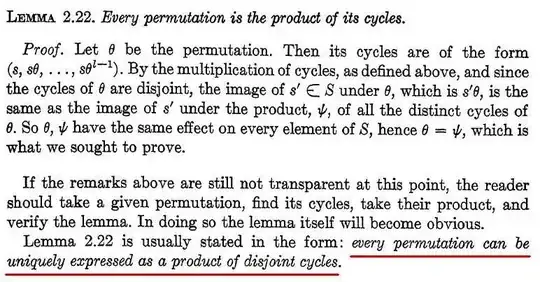
Recall that each cycle is defined as a map (a circular permutation, i.e. a bijective function of a particular kind) on its elements. Thus, an orbit, which is an unordered set, when written out as an ordered tuple, gives a cycle. Cycles of length 1 also are included in this representation.
Thus, the "uniquely" you underlined is to be interpreted to mean modulo one thing: the different orbits themselves can be written out in any order, so that $(1,2,3)(6)(4,5)$ is considered to be the same permutation as the earlier one. Also, each cycle itself can be written out in many ways, so $(2,3,1)(6)(5,4)$ is the same permutation as before; this is because a cycle is defined to just be a map from a set of elements (an orbit) to itself, and hence the cycle $(1,2,3)$ and $(2,3,1)$ are the same cycle (i.e. are the same bijective function).
Thus, the permutation $(1,2,3)(4,5)(6)$ is uniquely expressed as a product of disjoint cycles, i.e. it cannot be expressed in any other way. Since these orbits (i.e. disjoint cycles) are unique, and since the order in which a circular permutation is written out determines (and is determined by) the cycle/map, the assertion you underlined follows.
To summarize, the statement you underlined says two things: that the orbits that partition $S$ are uniquely determined (in this case, to be $\{1,2,3\},\{4,5\},\{6\}$), and the bijective function (cycle) from each orbit to itself is also uniquely determined (in this case, to be $1 \mapsto 2, 2 \mapsto 3, 3 \mapsto 1$ for one of the cycles, $4 \mapsto 5, 5 \mapsto 4$ for another cycle, and $6 \mapsto 6$ for another cycle).