Bisectors of angles $A$, $B$ and $C$ of a triangle $ABC$ intersect its circumcircle at $D$, $E$ and $F$ respectively. Prove that the angles of the triangle $DEF$ are $90^{\circ}-\frac{1}{2}A$, $90^{\circ}-\frac{1}{2}B$ and $90^{\circ}-\frac{1}{2}C$.
Asked
Active
Viewed 60 times


1 Answers
1
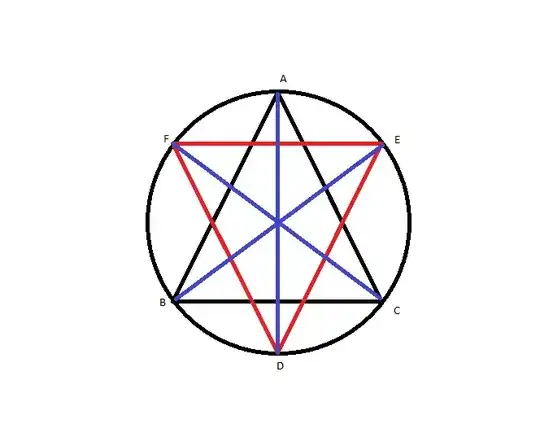
Using the following theorems:
$1$ : 'Sum of opposite angles in a cyclic quadrilateral are $180$'
$2$ : 'Angles in the same segments are equal'
$$\angle BDC = 180-\angle A$$ $$\angle EDC = \angle EBC = \angle \dfrac{B}{2}$$ $$\angle FDB = \angle FCB = \angle \dfrac{C}{2}$$ $$\angle FDE = \angle BDC - \angle EBC - \angle FCB$$ $$\angle FDE = 180-\angle A - \angle \dfrac{B}{2} - \angle \dfrac{C}{2}$$ $$\angle FDE = 90 - \angle \dfrac{A}{2}$$
Similarly we get the other two angles as $90 - \angle \dfrac{B}{2},90 - \angle \dfrac{C}{2}$
Hope the answer is clear !

lsp
- 4,745