I watched the following video to get more intuition behind Borsuk-Ulam Theorem.
The first part of the video was very clear for me, as I understood it considers only $R^2$ dimension and points $A$ and $B$ moving along the equator and during the video we track the temperature of point $A$ and $B$ along the equator.
The following is the picture from the second part.
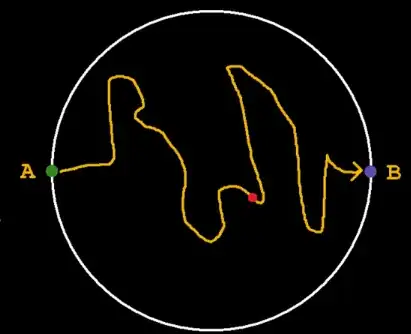
In the second part $R^3$ is considered, and instead of tracking the temperatures along the equator, we track the temperature along the arbitrary path from $A$ to $B$ along the sphere, but along this part we don't move $A$ and $B$ there is no intersection of temperatures as in was in the first part (the most confusing phrase is 4:45 "as $A$ goes to $B$ is goes from being colder than $B$ to hotter than B", why? it just goes to the $B$). I don't understand how the assumption that there are a point on the track where the temperature is as in the point $B$ can help us, even if it's true is not what we need we need the temperature in the point $A$ to be equal the temperate in the point $B$.
The second assumption is to consider all antipodal points with the same temperature and consider all the points on the track with the same temperature of the opposite point, so as result we have a "club" of the intermediate point with the different temperatures, but all their temperatures equal to the temperature of the opposite point, given so how can we connect them by the line.
I have some problems in understanding the idea of the second part, would appreciate for help.


