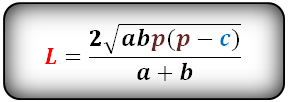
As mentioned in a comment, the path to a polynomial relationship between area and angle bisectors is straightforward (though potentially computationally-expensive) using, say, the method of resultants or Groebner bases to eliminate side-lengths $a$, $b$, $c$ from the system
$$\begin{align}
d^2 &= \frac{bc}{(b+c)^2}((b+c)^2-a^2) \\[4pt]
e^2 &= \frac{ca}{(c+a)^2}((c+a)^2-b^2) \\[4pt]
f^2 &= \frac{ab}{(a+b)^2}((a+b)^2-c^2) \\[4pt]
16 t^2 &= (a+b+c)(-a+b+c)(a-b+c)(a+b-c)
\end{align}$$
where $d$, $e$, $f$ are the lengths of angle bisectors and $t$ is the area of the triangle.
My laptop with Mathematica struggles with the elimination process. There could be ways to optimize, but it turns out that I don't have to work that hard.
The 2005 paper "Area of a Triangle and Angle Bisectors" (PDF link via arXiv.org) by Buturlakin, et al. (2005), discusses how the area of a triangle isn't expressible in terms of the angle bisectors using radicals. Although it doesn't give an explicit polynomial relationship between area and bisectors, it does give relationships involving inradius $r$.
Let us define
$$s_2 = \frac1{d^2}+\frac1{e^2}+\frac1{f^2} \qquad s_3 = \frac1{def} \qquad s_4= \frac1{d^2e^2}+\frac1{e^2f^2}+\frac1{f^2d^2}$$
Then we have
$$4s_2r^2t^2 - 8 s_3 r^3 t^2 = r^4 + t^2 \tag{1}$$
attributed to van Renthe Fink (1843), and
$$\begin{align}
0
&= \phantom{1}64r^{10} s_3^2 (s_2^2 - 4 s_4) \\
&- \phantom{1}64r^9 s_3 (s_2^3 - 10 s_3^2 - 4 s_2 s_4) \\
&+ \phantom{1}16r^8 s_2 (s_2^3 - 50 s_3^2 - 4 s_2 s_4) \\
&+ \phantom{1}32r^7 s_3 (10 s_2^2 - s_4) \\
&- \phantom{19}4r^6 (10 s_2^3 - 61 s_3^2 - 4 s_2 s_4) \\
&-188r^5 s_2 s_3 \\
&+\phantom{1}33r^4 s_2^2 \\
&+\phantom{1}28r^3 s_3 \\
&-\phantom{1}10r^2 s_2 \\
&+\phantom{19}1
\end{align}\tag{2}$$
attributed to H. Wolfe (1937). (The Wolfe polynomial cited in Buturlakin given for $1/(2r)$. I rewrote it for $r$.)
Eliminating $r$ from $(1)$ and $(2)$ is comparatively easy. The result(ant) is ... deep breath ...
$$\begin{align}
0 &= 16777216 t^{20} s_3^{12} (s_2^2 - 4 s_4) \\
&+ 2097152 t^{18} s_3^8 (s_2^6 - 2 s_2^3 s_3^2 - 10 s_3^4 - 6 s_2^4 s_4 +
8 s_2 s_3^2 s_4 + 8 s_2^2 s_4^2) \\[4pt]
&+65536 t^{16} s_3^4 \left(\begin{array}{c}
s_2^{10} + 12 s_2^7 s_3^2 - 120 s_2^4 s_3^4 + 90 s_2 s_3^6 \\
- 8 s_2^8 s_4 - 56 s_2^5 s_3^2 s_4 + 428 s_2^2 s_3^4 s_4 + 16 s_2^6 s_4^2 \\
+ 64 s_2^3 s_3^2 s_4^2 - 112 s_3^4 s_4^2 - 128 s_2 s_3^2 s_4^3
\end{array}\right) \\[4pt]
&-16384 t^{14} s_3^2 \left(\begin{array}{c}
5 s_2^8 s_3^2 + 58 s_2^5 s_3^4 - 392 s_2^2 s_3^6 + 2 s_2^9 s_4 \\
+ 5 s_2^6 s_3^2 s_4 - 134 s_2^3 s_3^4 s_4 + 167 s_3^6 s_4 \\
- 16 s_2^7 s_4^2 - 104 s_2^4 s_3^2 s_4^2 + 528 s_2 s_3^4 s_4^2 \\
+ 32 s_2^5 s_4^3 + 32 s_2^2 s_3^2 s_4^3 - 64 s_3^2 s_4^4
\end{array}\right) \\[4pt]
&+256 t^{12} \left(\begin{array}
14 s_2^9 s_3^2 + 432 s_2^6 s_3^4 + 500 s_2^3 s_3^6 - 519 s_3^8 \\
+ 24 s_2^7 s_3^2 s_4 + 28 s_2^4 s_3^4 s_4 - 10832 s_2 s_3^6 s_4 \\
+ 16 s_2^8 s_4^2 - 64 s_2^5 s_3^2 s_4^2 + 1824 s_2^2 s_3^4 s_4^2 - 128 s_2^6 s_4^3 \\
- 1024 s_2^3 s_3^2 s_4^3 + 3072 s_3^4 s_4^3 + 256 s_2^4 s_4^4
\end{array}\right) \\[4pt]
&-32 t^{10} \left(\begin{array}{c}
94 s_2^7 s_3^2 + 2243 s_2^4 s_3^4 + 9328 s_2 s_3^6 + 36 s_2^8 s_4 + 744 s_2^5 s_3^2 s_4 \\
- 3648 s_2^2 s_3^4 s_4 - 144 s_2^6 s_4^2 - 1536 s_2^3 s_3^2 s_4^2
- 7680 s_3^4 s_4^2 + 2048 s_2 s_3^2 s_4^3
\end{array}\right) \\[4pt]
&+ t^8\left(\begin{array}{c}
81 s_2^8 + 1568 s_2^5 s_3^2 - 21184 s_2^2 s_3^4 + 768 s_2^6 s_4
+ 24064 s_2^3 s_3^2 s_4 \\
+ 37888 s_3^4 s_4 - 3072 s_2^4 s_4^2 - 24576 s_2 s_3^2 s_4^2\end{array}\right) \\[4pt]
&-4 t^6 (27 s_2^6 + 352 s_2^3 s_3^2 - 424 s_3^4 +
32 s_2^4 s_4 + 320 s_2 s_3^2 s_4 - 128 s_2^2 s_4^2) \\
&+ 2 t^4 s_2 (27 s_2^3 + 80 s_3^2) \\
&-12 t^2 s_2^2 \\
&+ 1
\end{align} \tag{$\star$}$$
Barring transcription errors, equation $(\star)$ gives an implicit relation between the area of a triangle and the lengths of its angle bisectors. (A numerical test against a random-ish GeoGebra model worked, so this can't be too far off.)
Now ... Where's that eternal fame I was promised?
If $e=f$, equation $(\star)$ reduces to
$$\begin{align}
0 &= ( 4 t - d f )( 4 t + d f ) \\
&\cdot (
256 t^6 d^4
+ 16t^4f^2 ( 9 d^6 + 4 d^4 f^2 + 4 d^2 f^4 + f^6 )
- t^2 d^2 f^6 ( 24 d^4 + 8 d^2 f^2 + 3 f^4 )
+ d^6 f^{10}
)^2 \\
&\cdot(
16 t^6 ( 4 d^2 - f^2 )
+ t^4 d^2 ( 64 d^4 - 32 d^2 f^2 + 9 f^4 )
- 2t^2 d^6 f^2 ( 8 d^2 + 3 f^2 )
+ d^{10} f^4 )
\end{align}$$
If $d=e=f$, then we have
$$(3 t^2 - d^4) (4 t - d^2)^3 (4 t + d^2)^3 (16t^4 + 19d^4t^2-d^8 )^3= 0$$
of which the first factor corresponds to the case of the equilateral triangle. The second and fourth factors yield positive real roots, so we aren't getting uniqueness from this thing.