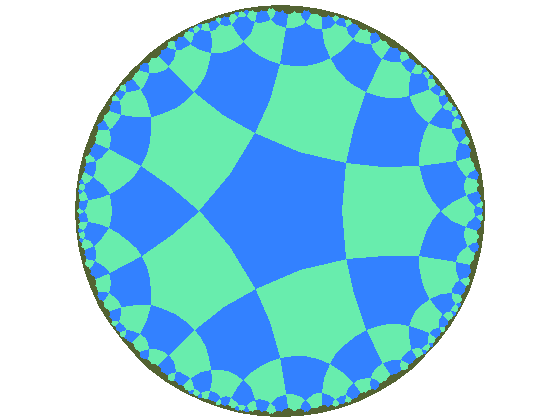
Here's the problem.
Each node will take up some minimum amount of area (if layed out on the surface of the earth) or volume (if arrayed in space). Let's use $A$ to denote this amount.
Now let's count nodes:
- Pick one crossover point which we'll call the base. There's 1 node at the base.
- At distance 1 away from the base of your network, there are 4 more crossover points, for a total of 4 more nodes.
- At distance 2 away from the base of your network, there are 12 more crossover points, for a total of 12 more nodes.
- As you continue at further and further distance, the number of nodes at distance $n+1$ is always at least 2 times larger than the number of nodes at distance $n$.
To put this concisely, the number of nodes which exist at distance $\le n$ is growing exponentially, faster than the exponential function $2^n$. There's actually an exponential growth base larger than $2$, but $2$ is pretty easy to see if you stare at that diagram, and it's already large enough to be able to see the looming disaster.
So, the total amount of area/volume occupied by the nodes at distance $\le n$ is at least as large as $A \cdot 2^n$.
But now we encounter a serious problem: In our universe, the nearby geometry (out to, say, the nearest galactic cluster) is very closely approximated by a Euclidean metric. And the amount of volume in a space of radius $n$ is growing only cubically. The exact Euclidean volume of a ball of radius $n$ in Euclidean space is $\frac{4\pi}{3} n^3$, and with the tiny perturbations of metric arising from general relativity, the actual volume formula is going to be very very close to the exact Euclidean formula, going out a very very large distance.
So you're gonna run out of space pretty quickly if you actually try to build this cloud machine.