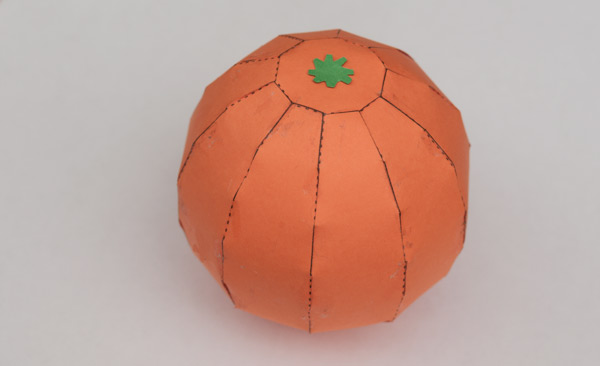
2

Using stereographic projection of a sphere, $S^2$, we can obtain the one point compactification of $\mathbb{R}^2$ is sphere, i.e. $S^2$ can be thought of as $\mathbb{R}^2 \cup \{ \infty \}$. Now I am wondering how can $S^2$ be obtained by quotienting $\mathbb{R^2}$.

I have an idea (maybe it's vague),that can we identify the boundary of $\mathbb{R}^2$ to one point and other points as singletons. But I have thought for a while that the boundary of $\mathbb{R}^2$ is not in $\mathbb{R}^2$, so we may not get sphere by quotienting the space $\mathbb{R}^2$ only.

So I think we have to take $\mathbb{R}^2$ union its boundary at first then proceed in the above way I said. But I have no confidence in my intuition. Please, someone help me to clear my doubts. (But I know it can be done by any bounded closed subset of $\mathbb{R}^2$ and identifying its boundary to one point.)

ViktorStein
  • 4,838
SJA
  • 174

2 Answers2

1

$\mathbb R^2$ has no boundary. But that doesn't matter, we can still get $S^2$ by quotienting $\mathbb R^2$: take the open unit disc and collapse every point which is not in the disc into a single point. This point is essentially the pole needed for the one-point compactification of the unit disc.

Vercassivelaunos
  • 13,226
  • 2
  • 13
  • 41
0

$\mathbb{R}^2$ does not have a boundary. [It is a good exercise to assume that there is a point in the boundary, and use the definition to arrive at a contradiction to really know that the boundary of $\mathbb{R}^2$ is empty.]

It almost seems like you are trying to find ways of just stretching, shifting, squeezing $\mathbb{R}^2$ to try to get the sphere. But these operations are all homeomorphisms, and we know that $\mathbb{R}^2$ is not homeomorphic to the sphere because $S^2$ is compact while $\mathbb{R}^2$ is not. So $\mathbb{R}^2$ must be missing something.

As you know, $\mathbb{R}^2$ is missing a single point. The easiest way of picturing the typical homeomorphism of $\mathbb{R}^2 \cup \{\infty\}$, i.e. $\mathbb{R}^2$ 'plus a point', with $S^2$ is to recall that $\mathbb{R}^2$ is homeomorphic with the unit disc. So we may as well as think of $\mathbb{R}^2$ as being the unit disc. Then picture $\{\infty\}$ as some other 'point' outside the unit disk. We pick up the unit disk, fold the boundary of the unit disk towards the point we have called $\{\infty\}$ until they all meet up there and then glue them. You then have the sphere and we see the homeomorphism. You can see it a bit in the following image of the sphere, accepting that the 'top' of this origami (the decagon along with the green splot) is the point $\infty$.