3

I read an article by Joseph O'Rourke. It is about an algorithm for finding a minimum bounding box in three-dimensional this article.

He said there:

The Gaussian sphere is dual of the convex polyhedron.

and also:

Gaussian sphere partitions the surface of the unit sphere to into the convex region, one for each vertex of the convex polyhedron, such that if n is a unit vector from the origin whose tip lies in the convex region then the plane through the convex region with normal n is a supporting plane for the polyhedron.

My questions are:

What is a "Gaussian sphere"

Which algorithm helps to create it?

I search on the net but gained nothing.

Any tip that makes a way to know it, makes me happy.

ALIN
  • 111
  • 2
    @user64742 I know the Gaussian surface and I know the Gaussian sphere by a point charge. It is not what I want and what the article said. – ALIN Aug 20 '20 at 06:36

1 Answers1

1

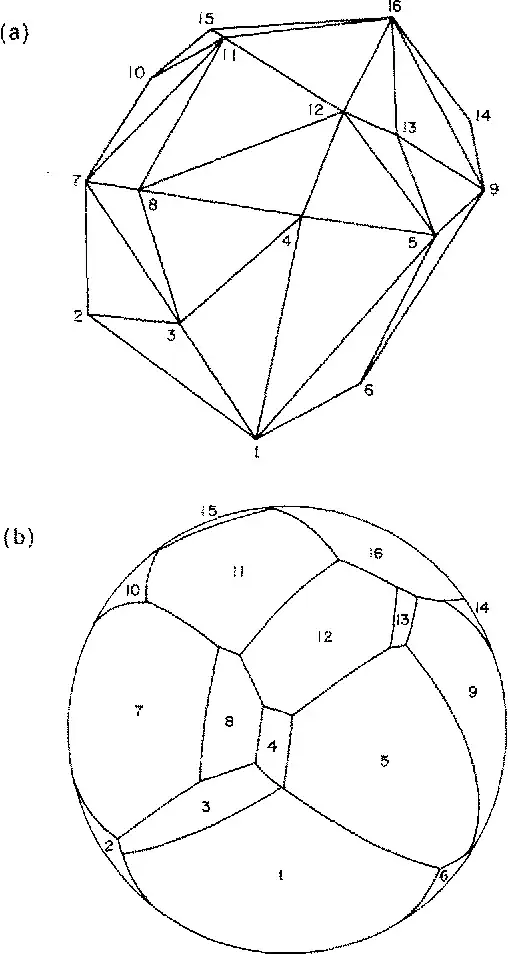
Here is Fig.2.1 from that paper.

Each vertex on the polyhedron maps to a face on the sphere, each of which is a convex geodesic polygon, geodesic in the sense that the edges are subarcs of great circles. Each face of the polyhedron maps to a vertex on the sphere. And each edge $v_1 v_2$ on the polyhedron maps to an edge on the sphere shared between the two regions corresponding to $v_1$ and $v_2$.

  • Thanks for your answer and article. I didn't see your answer so far. I tried to write a code your algorithm about a year ago. I can't understand the final part; however, I wrote it in Fortran language. – ALIN Oct 16 '21 at 21:16
  • @mr_e_man: This depends on definitions, I think. If one takes a polyhedron formed by a cube with an attached square pyramid, it is convex. Invert the protruding pyramid to instead dent into the cube, and all faces and arrangements about each vertex are identical. So the answer depends on the meaning of "spherical vertex figure." Under a reasonable definition, Yes, this must be a convex polyhedron. – Joseph O'Rourke May 05 '22 at 18:26
  • @mr_e_man: Thanks for the correction. In both polyhedra, each vertex is incident to the exact same face angles: 90,90,60,60. Of course the normals to those four faces are differently distributed. – Joseph O'Rourke May 05 '22 at 20:13