1

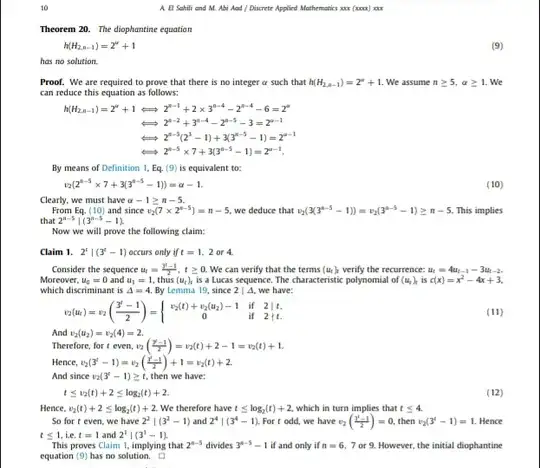
I was reading a paper in graph theory "About the number of directed paths in tournaments", the authors used p-adic order to prove a theorem.

I am new to this field, I made some searches and I didn't find what I was looking for.

They wrote: $v_2(3^t-1) \ge t$

I think this is true always (not only in this paper) but I don't know why.

A similar equality that I guess undergo the same property is,

$$v_2(2^{n-5}×7+3(3^{n-5}-1))=\alpha -1$$

Clearly, we must have $\alpha -1\ge n-5$.

I also didn't know why the last inequality is true.

I read on a site that $v_p(a+b)= min\{v_p(a), v_p(b)\}$ under some conditions. I think they used this here with some other property.

Can anyone clear it up please and maybe add a link to where I could find these properties?

This is a picture of the proof and a link to the paper.
enter image description here

https://www.sciencedirect.com/science/article/abs/pii/S0166218X19304226

  • 3
    But $v_2(3^3 - 1) = v_2(26) = 1 < 3$, so I don't think the statement is true for all $t$ – Mike Daas Sep 28 '20 at 08:55
  • I added the proof please check it out. – Fareed Abi Farraj Sep 28 '20 at 11:09
  • 2
    Look at Claim 1: It says it's only true for $t=1,2,4$, so quite the opposite to what you say. Basically they started with an equation (from theorem 20), then derived that for that equation to be true, $v_2(3^t-1) \ge t$ is necessary. Then they proved Claim 1 that the latter is only true for $t=1,2,4$, which didn't fit other conditions, so their initial equation can't be true and has no solution. – Ingix Sep 28 '20 at 12:35
  • 1
    Fully agree with what @Ingix says. As an aside: That $v_2(3^t-1)=v_2(t)+2$ for even $t$ and $=1$ for odd $t$ is a special case of the LTE lemma, cf. https://math.stackexchange.com/a/3733159/96384. So most of the proof of claim 1 there, with Lucas sequences and discriminants, seems like overkill. – Torsten Schoeneberg Sep 28 '20 at 16:12

0 Answers0