1

So I am trying to sketch a set of complex numbers that is characterized by inequality: $ Re((1+i)z^2) < 0 $.

I know that if I take $ z = a + bi $ , then: $$Re(z^2) \implies (a + bi)^2 = a^2 + 2abi - b^2 \implies Re(z^2) = a^2 - b^2$$

Similarly:

$$Re(z^2(1+i)) \implies (a^2 + 2abi - b^2)(1+i) = a^2 + 2abi - b^2 + a^2i - 2ab - b^2i \implies Re(z^2(1+i)) = a^2 - 2abi + b^2 = (a-b)^2 $$

So how am I supposed to sketch a set of complex numbers $(a-b)^2 $ on a 2D plane? Or did I do something wrong?

theman
  • 67

2 Answers2

2

Some facts:

We require the real part to be less than zero, which means $(1 + i)z^2$ must be located on the left half of the complex plane. In terms of the argument, this means $(1+i) z^2$ must have an argument between $\pi/2$ and $3\pi/2$, plus some integer multiple of $2\pi$.

Squaring a complex number doubles its argument.

Multiplying a complex number by $1+i$ increases its magnitude by $|1+i| = \sqrt{2}$ and rotates it by $\pi/4$; i.e., the argument is increased by $\pi/4$.

Therefore, $$\arg((1+i)z^2) = \frac{\pi}{4} + 2\arg (z)$$ and we need this to be between $\pi/2$ and $3\pi/2$, or between $5\pi/2$ and $7\pi/2$. This gives us $$\frac{\pi}{8} < \arg (z) < \frac{5\pi}{8} \quad \text{or} \quad \frac{9\pi}{8} < \arg (z) < \frac{13\pi}{8}.$$ Using interval notation, we can also write this as $$\arg (z) \in (\tfrac{\pi}{8}, \tfrac{5\pi}{8}) \cup (\tfrac{9\pi}{8}, \tfrac{13\pi}{8}).$$

We can visualize this region in the complex plane by coloring quadrants I and III (i.e., those regions where $\Re(z)\Im(z) = 1$, and then rotating those regions by $\pi/8$ counterclockwise.
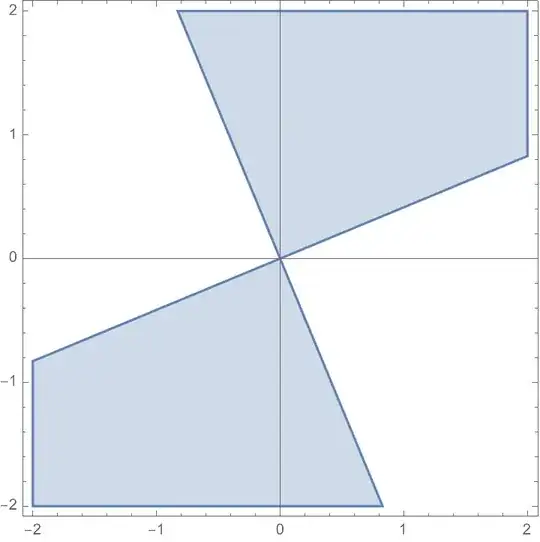
enter image description here

heropup
  • 135,869
  • Thank you so much Sir! It is the first time anybody showed me a methodical way of dealing with that type of cases. I thought that I need to use real and imaginary part. – theman Nov 07 '20 at 01:44
1

When dealing with complex number, polar form is almost always more useful than breaking it into real and imaginary part.

$$ Re((1+i)z^{2})<0\implies \frac{\pi}{2}<\arg{((1+i)z^{2})}<\frac{3\pi}{2} $$

Now we use the following $$ \begin{align} \arg{((1+i)z^{2})}&=\arg{(1+i)}+ 2\arg{(z)}\\ &=\frac{\pi}{4}+2\arg{(z)} \end{align} $$ Substitute this to the first equation to obtain $$ \frac{\pi}{8}<\arg{(z)}<\frac{5\pi}{8} $$

acat3
  • 11,897