Derivatives show us how fast something is changing at any point. For example; the gradient of the graph of $y = x^2$ at any point is twice the value of $x$ thereat. The process of finding the derivation of a gradient / slope of a function $y=f(x)$ or $y = x^2$ is as follow.
Pick any two points $A$ and $B$ close to each other on the curve of $y =x^2$. The coordinates of $A$ on the curve are $(x, y)$ or $(x, x^2)$. Add $Δx$ at $A$ as usual. When $x$ increases by $Δx$, then $y$ increases by $Δy$. The $x$ changes from $x$ to $(x +Δx)$ while $y$ changes from $y$ to $(y + Δy)$ or $f(x)$ to $(x+Δx)^2$. Thus the $x$ and $y$ coordinates of $B$ on the curve are $(x + Δx, y + Δy)$ or $([x+Δx, (x+Δx)^2].$ Now the instantaneous rate of change is given by
$$\frac{Δy}{Δx} = \frac{[(x + Δx)^2 – x^2]}{[x + Δx - x]}$$
$$\frac{Δy}{Δx} = \frac{[x^2 + Δx^2+2xΔx − x^2]}{ Δx}$$
$$\frac{Δy}{Δx} = \frac{[2x + Δx]}{ 1}$$
Reduce $Δx$ close to zero by taking limit ($Δx$ to $dx$ and $Δy$ to $dy$)
$$\frac{Δy}{Δx} = 2x + dx$$
$$\frac{Δy}{Δx} = 2x \tag1\label{eq1} $$ OR
$$dy = 2x.dx \tag2\label{eq2}$$
ABC is an infinitesimal triangle made by $dx, dy$, and hypotenuse or slope of tangent where point $A$ and $C$ are always on the curve. Length of $AB$ = Base = $dx$, Length of $BC$ = Perpendicular= $dy$ and Length of Hypotenuse = $AC$. $\angle CAB$ or $\angle BAC$ is the slope of a tangent
According to the aforementioned $\eqref{eq1}$ or $\eqref{eq2}$
•$\frac{dy}{dx}$ is directly proportional to $x$ or $\angle CAB$ is directly proportional to $x$.
• $dx$ is indirectly proportional to $x$ OR $x$ is inversely proportional to $dx$.
• $dy$ is directly proportional to $x.dx$ or $dx$
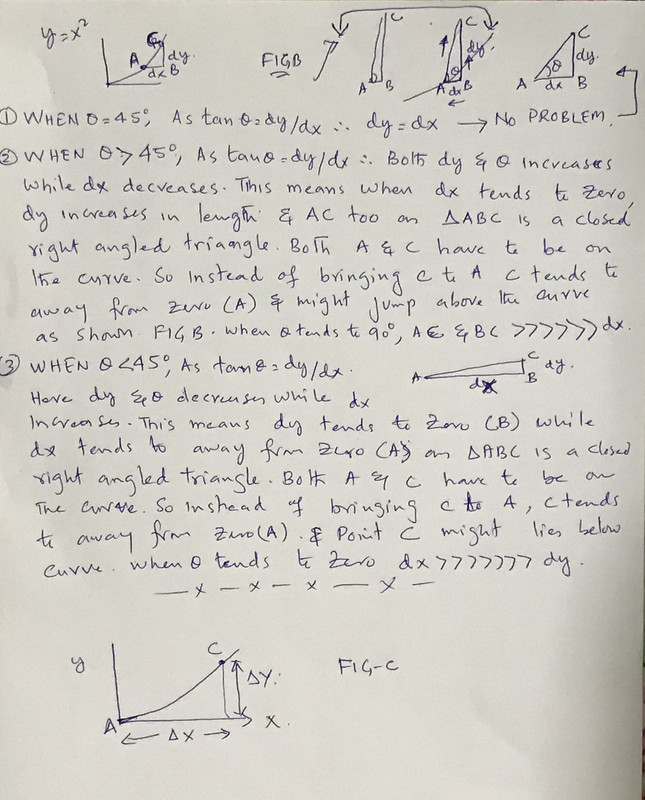
The length of $dx > dy$ when $\angle CAB < 45$ degrees The length of $dx = dy$ when $\angle CAB = 45$ degrees The length of $dx < dy$ when $\angle CAB > 45$ degrees.
The proportionality of both the $\angle CAB$ and $dy$ with $x$ are in contradiction with the proportionality of $x$ and $dx$ in the triangle $ABC$ after probing the equation of $\frac{dy}{dx} = 2x$ beyond its derivation on a graph of $y = x^2$. When $x$ increases; $dx$ decreases, $dy$ increases, and $\angle CAB$ increases. This means $AC$ also increases and ultimately SECANT when $x$ increases. Our goal is to bring $dx, dy$ and $AC$ to zero (not away from zero either positively or negatively - Point $C$ has to be on the curve) or secant to tangent by reducing them close to zero but here $dx$ heads toward zero but $dy$ and $AC$ increases when $x $ increases on axis mathematically.
Although the difference in the length of $dx$ and $dy$ can be noticeable clearly on the graph if we examine the triangle $ABC$ at two different points for a gradient ($\frac{dy}{dx}$), say when an $\angle BAC = 0.1$ degrees and 89.9 degrees on the curve but UNIT CIRCLE is the best example for observing the change in an $\angle CAB$ (say 0.1 and 89.9 degrees) of a triangle $ABC$ for $dy$ and $dx$ and the comparison of their lengths.
$RISE = dy = 2x$ and $RUN = dx = 1$ (always constant) in a GRADIENT of 1 in $2x$ which we obtained from the $\eqref{eq1}$ of $\frac{dy}{dx}=\frac{2x}{1}$ at any point on the curve when there is no difference between secant and tangent – No idea how do we get $\frac{dy}{dx} = 2x.dx$ but above said contradiction may be due to the introduction of another curve of $y =(x+dx)^2$ at a point where we seize $x$ or $y=x^2$ deliberately and introduce delta $x$ OR when function $y = f(x)$ changed to $y=f(x+Δx)^2$. The value of $x$ has reached to its maximum value instead of unlimited when a curve $y=x^2$ doesn’t continue anymore at a point where we introduce delta $x$ or $dx$ as $y=x^2$ and $y =(x+dx)^2$ are two different types of curve (two diffrent functions).
Further, integration is the reverse process of differentiation. Although delta $x$ or $dx$ is ignored during the process of derivation of $\frac{dy}{dx}$ because of their small values but we can’t ignore them in the process of integration which makes a lot of difference in summation. They can’t be disappeared forever and should resurface during the process of integration or summation.
Similarly, $dy$ is the small vertical change in $y$, therefore, we take the sum of all the small vertical lengths [dy(s)] not the whole slice or y-coordinate(s) from zero to its value on the curve when we integrate both sides of the equation of $dy = 2xdx$ but it turns into function of $x^2$ or area under the graph – no idea how but summation of vertical lengths on a graph gives vertical length only not curve?
The derivation of the natural relationship of a gradient of 1 in $2x$ at any point with $y=x^2$ or $\frac{dy}{dx}=2x$ is still unbeknownst to illuminates - Anyone who is in agreement with all above unless satisfied by logic.
Below figure may help with the above.