4

Consider the function $f(x) = ax(1-x)$. I have to show that if $ 1 < a < 3$ that the fixed point $p_2 = \dfrac{a-1}{a}$ is attractive, and if $ 3 < a < 4$ it is repulsive.

I actually have no idea how to do this. I found that the top of the function is at $ ( \dfrac{1}{2}, \dfrac{a}{4} )$ and I have found that $f'(0) = a$ and $f'(\dfrac{a-1}{a}) = 2-a$, but I don't know what to do with this.

iEvenLift
  • 117

1 Answers1

4

Your function is a 'logistic map' and the trick is to compare $|f'(p_2)|$ to $1$. From Wikipedia he have indeed :
"If the function $f$ is continuously differentiable in an open neighbourhood of a fixed point $x_0$, and $|f'(x_0)|<1$, attraction is guaranteed."

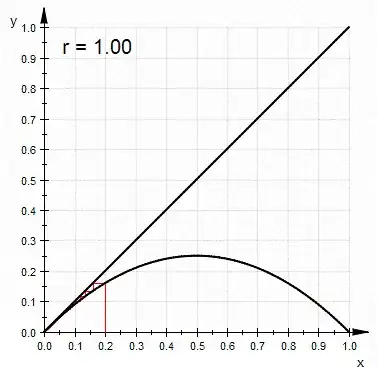
This link to Wikipedia's picture may give you an intuitive explication (warning the vertical scale is a little too elongated). The iterations start at $x=-1$ and clearly converge at the right : now let's suppose that the vertical line at the right would go down a little more (supposing that the slope is steeper with $\ f'(x_0)<-1\ $) then we would go farther than we were at the top and go away from the limit instead of approaching as we do here (the spiral would be divergent).

linked wikipedia picture

You found $\ f'\left(\dfrac{a-1}{a}\right) = 2-a$

But for $\ 1<a<3\ $ we have $\ 2-3<2-a<2-1\ $ and obtain that $\ \left|f'\left(\dfrac{a-1}{a}\right)\right|<1$

The repulsive part will be handled the same way.

Btw Wikipedia has a nice animation when the value of $a$ changes. animation
Raymond Manzoni
  • 43,021
  • 5
  • 86
  • 140
  • Re the quote from Wikipepdia: I believe we can replace "continuously differentiable" with "differentiable", and the same result holds, since we have $-1<\dfrac{f(x)-p}{x-p}<1$ for $x$ in a symmetric neighborhood of $p$, so long as we choose it small enough. – Eric Auld Sep 18 '14 at 22:27
  • @EricAuld: Consider $f(x):=2,x^2,\sin(1/x)$ for $x \neq 0$ and $0$ else. The (discontinuous) derivative will oscillate wildly between $-2$ and $2$ near $0$. – Raymond Manzoni Sep 19 '14 at 00:22
  • I agree that the derivative will oscillate wildly (though it will stay bounded); however, $\dfrac{|f(x)|}{|x|}\leq \rho < 1$ in a neighborhood of zero (by definition of the derivative), and that proves that $0$ is an attractive fixed point. – Eric Auld Sep 19 '14 at 00:48
  • @EricAuld: I'll admit your use of the differentiability to prove that we have a contraction mapping. My point was that the inequality $,|f'(x)|<1$ could have been wished for a neighborhood of the fixed point $x_0$ (no such neighborhood exists in my example) even if not required explicitely by Wikipedia's sentence. This comment can't be a substitute to a discussion at Wikipedia but I can imagine different reasons to suppose class $C^1$ : the fixed point is searched (not supposed known) so that a finite interval is wanted to apply the theorem, the fixed point doesn't admit a closed form, – Raymond Manzoni Sep 19 '14 at 13:34
  • we are using fixed precision (and obtain an infinity of 'nearly solutions' in my example !), Wikipedia could suppose a specific context (there are many fixed points theorems), other stability issues could be important (additional parameter(s)), the problem could be a physicist's one (their functions are usually supposed analytic or distributions) and so on... – Raymond Manzoni Sep 19 '14 at 13:34