2

enter image description here

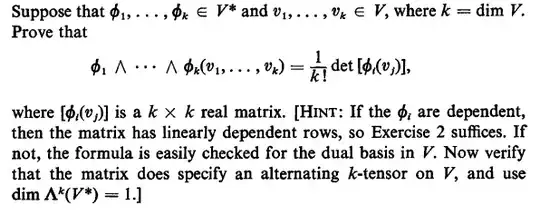
The end of the hint "The matrix specify an algernating $k$-tensor on $V$, and dim$\bigwedge^k(V^*)=1$" does not make sense to me.

In my not very assured understanding, the $k$-tensor $\bigwedge^k(V^*)$ eats $k$ vectors and gives a real number, like the determinant operator does, therefor the dimension is 1. Is this correct? Then how can I proceed?

Also, I am award of this theorem but not sure if {$\phi_1, \ldots, \phi_k$} is a basis. enter image description here

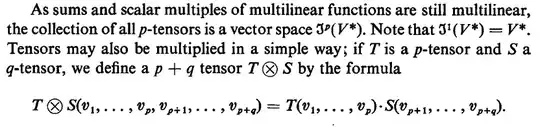
P.S. Definition of Tensor Product enter image description here Thank you~

1LiterTears
  • 4,572
  • 2
    Check my answer on http://math.stackexchange.com/questions/418999/the-interior-product-and-the-isomorphism-bigwedgekv-otimes-bigwedgenv/419157#419157 $dim \wedge^k V*=1$ because the only non trivial wedge product of degree $k$ constructed with all the basis elements $e_1,\dots,e_k$ of $V$ is given by $e_1\wedge\dots\wedge e_k$, up to permutations. – Avitus Jun 21 '13 at 17:47
  • Let me take a careful look at it, thanks @Avitus. – 1LiterTears Jun 21 '13 at 17:54
  • 3
    @Jellzfish one question: is the book Greub's "Multilinear Algebra"? It is a great book :-). I think that you just need to check the $n=2$ case on that book. Is the map defined as follows: $\omega_1\wedge\omega_2(v_1,v_2):=i_{\omega_1}(i_{\omega_2}(v_1,v_2))$, up to normalization? (I am using the notation of my answer in the link above). – Avitus Jun 21 '13 at 18:00
  • 1
    Hello @Avitus, I am reading GP's Differential Topology. But the algebra stuff(multilinear/exterior) really baffles me. – 1LiterTears Jun 21 '13 at 18:09
  • 1
    ok, no problem. Could you please write GP's formula for the $n=2$ case? I mean, the formula for $\wedge^2 V*\otimes V^{\otimes 2}\rightarrow \mathbb K$. Once we have that, we can prove the higher cases – Avitus Jun 21 '13 at 18:11
  • Hi @Avitus, do you mean this guy? $$\text{Alt}(T) = \frac{1}{p!}\sum_{\pi \in S_p}(-1)^nT^n,$$ where $T \wedge S \in \wedge^{p+q}(V^*)$ is defined to be Alt($T \otimes S$). – 1LiterTears Jun 21 '13 at 18:16
  • 1
    Hi @Jellyfish, as the text says "prove that", before the exercise the map $\wedge^{k} V^{*} \otimes V^{\otimes k} \rightarrow \mathbb K$ has been already defined. I am interested in that definition. – Avitus Jun 21 '13 at 19:08
  • Hello @Avitus - I added to the problem statement. – 1LiterTears Jun 21 '13 at 19:33

2 Answers2

4

Let us consider a finite dimensional vector space $V$ over a field $\mathbb K$ of characteristic zero (we can take $\mathbb K=\mathbb R$ or $\mathbb C$, for example). Let $k$ be the dimension of $V$: when dealing with vectors in $V^{\otimes k}$ or ${V^{*}}^{\otimes k}$ we refer to $k$ as the "weight" of the tensor. This terminology is standard in homological algebra.

To reconstruct the result you want to prove, we need to consider a couple of maps. The first one is the alternating map

$$Alt^{k}_{*}: \wedge^{k}V^{*}\rightarrow Alt^k(V^{*})\subset V^{*}\otimes\dots\otimes V^{*},$$

with

$$Alt^{k}_{*}(\omega_1\wedge\dots\wedge \omega_k):=\frac{1}{k!}\sum_{\pi\in S_k}(-1)^{\pi} \omega_{\pi(1)}\otimes\dots\otimes\omega_{\pi(k)},$$

denoting by $Alt^{k}(V^{*}):=Im(Alt^{k}_{*})$ the linear subspace of $V^{*}\otimes\dots\otimes V^{*}$ ($k$-times) consisting of all "alternating" tensors of weight $k$. $Alt^{k}_{*}$ is an isomorphism.

The second map we need to consider is

$$\varphi:(V^{*}\otimes\dots\otimes V^{*})\otimes(V\otimes\dots\otimes V)\rightarrow\mathbb K,$$

where

$$\varphi(\omega_{1}\otimes\dots\otimes\omega_{k}\otimes v_{1}\otimes\dots\otimes v_{k}):=\prod_{r=1}^k\omega_r(v_r).$$

$\varphi$ is the (I d not discuss unicity here) multilinear extension of the duality $V^{*}\otimes V\rightarrow \mathbb K$ to the components of weight $k$ of the tensor algebras

$$ T(V^{*})=\bigoplus_{k\geq 0} {V^{*}}^{\otimes k} $$

$$T(V)=\bigoplus_{k\geq 0} V^{\otimes k} $$

In summary, we want to characterize the map (always focusing on weight $k$ tensors)

$$\varphi\circ(Alt^{k}_{*}\otimes 1): \wedge^{k}V^{*}\otimes (V\otimes\dots\otimes V )\rightarrow \mathbb K.$$

The above map gives us the formula of the "pairing" in your question.

It follows that, choosing a basis $\{e_i\}$ for $V$ and the dual basis $\{\omega_i\}$ for $V^{*}$ the composition

$$\varphi(Alt_{*}(\omega_1\wedge\dots\wedge\omega_k)\otimes(e_1\otimes \dots\otimes e_k))=\frac{1}{k!}\sum_{\pi\in S_k}(-1)^{\pi}\varphi( \omega_{\pi(1)}(e_1)\otimes\dots\otimes\omega_{\pi(k)}(e_k))=\\ =\frac{1}{k!}\sum_{\pi\in S_k}(-1)^{\pi}\prod_{i=1}^k\omega_{\pi(i)}(e_i)=\frac{1}{k!}\det(A), $$

where $A$ is the $k\otimes k$ matrix with entries $A_{ij}:=\omega_{i}(e_j)$.

Considering dependent vectors $\omega_{*}$ results in having a zero determinant.
Avitus
  • 14,018
2

This is how I understood Avitus' proof. My version is much less involved - not involving $\varphi$ and the basis of $V^*$, $\omega_i$s. Don't feel right about this...

If $T \in \wedge^p(V^*)$ and $S \in \wedge^q(V^*)$, then the definition of their wedge product is $$T \wedge S := \text{Alt}(T \otimes S) \in \wedge^{p+1}(V^*)$$

Meanwhile, we have that $$\text{Alt}(T) = \frac{1}{p!}\sum_{\pi \in S_p}(-1)^{\pi} T^\pi.$$

Hence, for this problem, we have that \begin{eqnarray*} \phi_1 \wedge \cdots \wedge \phi_k (v_1, \cdots, v_k) & =& \text{Alt}(\phi_1 \otimes \cdots \otimes \phi_k (v_1, \cdots, v_k))\\ & = & \frac{1}{k!}\sum_{\pi \in S_k}(-1)^{\pi} T^\pi(v_1, \cdots, v_k)\\ & = &\frac{1}{k!}\sum_{\pi\in S_k}(-1)^{\pi} \phi_{\pi(1)}\otimes\dots\otimes\phi_{\pi(k)}(v_1, \cdots, v_k)\\ & = &\frac{1}{k!}\sum_{\pi\in S_k}(-1)^{\pi} \prod_{i=1}^k\phi_{\pi(i)}(v_i). \end{eqnarray*}

Without loss of generality, we choose a basis $\{e_i\}$ for $V$ %and the dual basis $\{\omega_i\}$ for $V^{*}$ . Then \begin{eqnarray*} \phi_1 \wedge \cdots \wedge \phi_k (e_1, \cdots, e_k) & =& \frac{1}{k!}\sum_{\pi\in S_k}(-1)^{\pi} \prod_{i=1}^k\phi_{\pi(i)}(e_i)\\ &=& \frac{1}{k!}\det(A). \end{eqnarray*} where $A$ is the $k\otimes k$ matrix with entries $A_{ij}=\phi_{\pi(i)}(e_i)$.

Considering dependent vectors $\omega_{*}$ results in having a zero determinant.

1LiterTears
  • 4,572
  • 1
    Your solution and mine are the same :-) Instead of $Alt(\phi_1\otimes...\otimes\phi_k(v_1,\dots,v_k))$ you should write $Alt(\phi_1\wedge...\wedge\phi_k)(v_1,\dots,v_k)$, i.e. apply the alternating map to $(\phi_1\wedge...\wedge\phi_k)$ and the result to the tensor $(v_1,\dots,v_k)$. Apart from this changes the idea and the solution are the same. So you have finished the exercise :) – Avitus Jun 22 '13 at 16:37
  • Oh thank you so much @Avitus! – 1LiterTears Jun 22 '13 at 20:55
  • You are welcome, @Jellyfish. You can "accept" the answer if you are satisfied with the new layout. Otherwise, please tell me where should I add some more detail. I would gladly do that. – Avitus Jun 23 '13 at 07:47
  • Certainly! Thanks a lot. Your answer is really a wonderful one!! Thank you @Avitus – 1LiterTears Jun 23 '13 at 21:02