2

I am facing the following problem. Let’s consider that there are 2 points that are not known. $${(x_0,y_0) (x_1,y_1)}$$ I know that from these 2 unknown points a set of quadratics passes $$f_i(x)=a_2x^2+a_1x+a_0 $$ $$0<i<n$$ i.e. the quadratics intersect at these two unknown points. For each one of the quadratics: I know the leading coefficient $$a_2$$ and a point $$(x_i,y_i)$$ Is it possible to find the intersection points of those polynomials? $${(x_0,y_0) (x_1,y_1)}$$ I think that if I know the leading coefficient and a point from four quadratics (n=4) I can define their intersection.

Is that right?
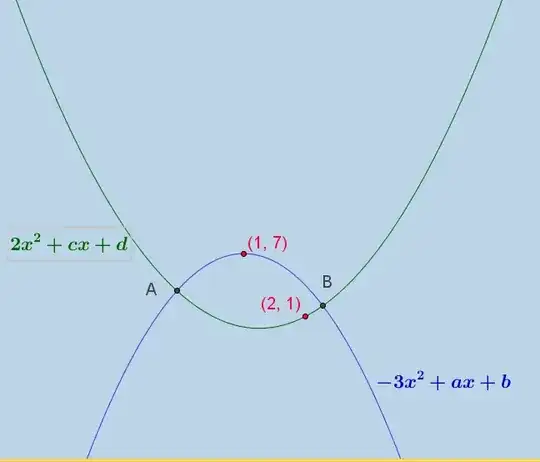
enter image description here

In this image two quadratics intercept at two unknown points.For this quadratics I only know a point and their leading coefficient. By using Newton Interpolation's Method: $$a_2=\frac{y_2-(y_0+\frac{y_1-y_0}{x_1-x_0}(x_2-x_0))}{(x_2-x_0)(x_1-x_0)}$$

In the previous equations the only unknowns are the 2 intersection points $$x_0,y_0 x_1,y_1$$. Having 4 equations like the previous one, does not solve the problem?

Herc11
  • 63
  • Are you trying to find $(x_0, y_0)$ and $(x_1, y_1)$ from 4 quadratics? Or from "the leading coefficient and a point" of 4 quadratics? – Henry Swanson Jun 21 '13 at 22:31
  • From 4 unknown quadratics. The only provided information is the leading coefficient of each quadratic and one $$x_i,y_i$$ of each quadratic. – Herc11 Jun 21 '13 at 22:35

1 Answers1

1

If I have interpreted your question correctly, then you don't have enough information to find the intersection points. As a simple example, consider when $a_2=0$ for all of the "quadratics" (i.e. we have straight lines). Then all you know is that you have a straight line passing through a particular point in each case, but you don't know their gradients so you have no way of knowing where they intersect. Now yes, these aren't really quadratics anymore, but the situation for $a_2\not = 0$ is the same- we know where the quadratics pass through, but we don't know enough about their gradient to determine exactly what quadratics they are and therefore can not find their intersections.

john
  • 5,633
  • In addition with the knoweldge of the leading coefficient I know a point of each polynomial. Let's use Newton Interpolation Method. $$a_2=0=\frac{y_2-(y_0+\frac{y_1-y_0}{x_1-x_0}(x_2-x_0))}{(x_2-x_0)(x_2-x_1)}$$ In this equation the unknowns are the $$x_0,y_0,x_1,y_1$$ i.e. the intersection points of the quadratics. If someone provide you with 3 more equations i.e. 3 quadratics where the only known info about them was the $$a_2 x_2 y_2$$ wont you be able to find the solution of the set of equations? – Herc11 Jun 22 '13 at 05:21
  • No. Let's think of the case where $a_2=0$ for all of the "quadratics" (really just straight lines). Saying a point that each line goes through doesn't tell you what line you actually have in each case. The lines through these sets of points could intersect at any other point just by choosing lines that go through both the original point and the intersection point. You may want to draw this if you're having trouble. – john Jun 22 '13 at 05:49
  • Note that the polynomials must have two points in common (intersection points)i.e. all the lines must intersect at two points. I think two points define a line i.e. you cant have two different lines passing through the same two points. – Herc11 Jun 22 '13 at 05:56
  • I'm not sure I fully understand your question then. You may want to provide an example of what it is you're trying to do – john Jun 22 '13 at 06:03