1

Question as follows.

Find the volume of the solid enclosed between the spheres $x^2+y^2+z^2=4$ and $x^2+y^2+z^2=4z \Leftrightarrow x^2+y^2+(z-2)^2=4$.

I constructed the following integral and after computation got the answer $\frac{16\pi}{3}$:

$$\int_{0}^{2\pi}\int_{0}^{\pi/2}\int_{0}^{2}\rho^2\sin{\phi}d\rho d\phi d\theta=\frac{16\pi}{3}.$$

The book says the answer should be $\frac{10\pi}{3}$ so I'd like to know what I did wrong. Are my bounds wrong? Should my integrand be different and not just the Jacobian?

Thank you.

jamesh625
  • 1,153
  • 1
  • 12
  • 23
  • 1
    Can you provide a bit more insight as to how you obtained that integral? The one you've constructed doesn't look much different than the volume integral for the area of a sphere of radius $2$ to me. – Alex Wertheim Jun 22 '13 at 02:31
  • @AWertheim Well, I constructed the two spheres and looked at their intersection. It looks a little bit like an ellipsoid. The two spheres intersect in the plane $z=1$ along the circle $x^2+y^2=1$. So $0\le \rho \le 2$, $0 \le \theta \le 2\pi$ and for $\phi$, the angle between the edge of the region and the $z$-axis varies between $0$ along the axis and $\pi/2$ when $\phi$ is along the $xy$-plane, hence $0\le \phi \le \pi/2$. And then I used the definition of volume $V=\iiint_{S}1dV=\iiint_{S}\rho^2 \sin{\phi} d\rho d\phi d\theta$. Which doesn't seem to be working... – jamesh625 Jun 22 '13 at 02:45
  • @jamesh625: The two spheres intersect in the plane $z=1$, but the circle they meet in is $$x^2+y^2+1^2=4\implies x^2+y^2=3,$$ so it has radius $\sqrt{3}$, not $1$. – Zev Chonoles Jun 22 '13 at 03:22

3 Answers3

3

Hint: I think it'd be easier to approach this in cylindrical coordinates.

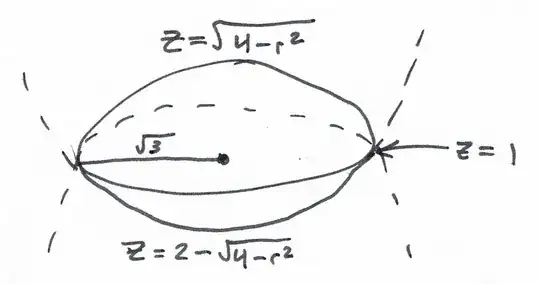
enter image description here

Thus, try out the integral $$\int\limits_0^{2\pi}\int\limits_0^{\sqrt{3}}(2\sqrt{4-r^2}-2)\,r\,dr\,d\theta$$

Zev Chonoles
  • 129,973
  • That's great and it works out to $\frac{10\pi}{3}$ but how would I go about it in spherical coordinates? – jamesh625 Jun 22 '13 at 03:28
0

Your integral's bounds are not nearly that simple. All you've integrated over is a ball that goes from the origin to a radius of 2. That doesn't describe the intersection of these two spheres. What you've done is like saying "I have a triangle whose corners are the origin, (0,1) and (1,0)" therefore my integral's bounds are $\int_0^1 \int_0^1 \, dx \, dy$. That's not right; you'd get twice the area of the triangle. You can't just take the max and min of each coordinate and integrate willy nilly.

What you can do, however, is use some symmetry. The circle of intersection between the two spheres defines a plane that cuts through the spheres. You can find the volume of the spherical sector defined by that plane restricting $\phi$ to some range $[0, \phi_0]$ (you will have to find the opening angle of the spherical sector to do this). You can then subtract off the volume of the cone that is cut off by the plane of intersection. What remains is the part of the sphere that is cut off by the plane of intersection. Since the geometry is symmetric, you can use this for the other sphere as well, and you're done.

Muphrid
  • 19,902
  • If I'm reducing it to cones though, won't I still be missing out on little slivers of volume? The cones don't exactly fill out the volume defined by the intersection between the two spheres, right? – jamesh625 Jun 22 '13 at 03:00
  • Oh wait, you mean to find the area of the cone plus the little bit on top right? (Making something like an icecream cone or snow cone?) And then if I get rid of the cone and then double that volume, I'll get the volume I wanted right? – jamesh625 Jun 22 '13 at 03:02
  • Yes, that's correct. – Muphrid Jun 22 '13 at 03:23
0

A related problem. You should plot the two spheres to see what's happening. Note that, the upper bounds of $\rho$ are different and the solution is

$$ \int_{0}^{2\pi}\int_{0}^{\pi/3}\int_{0}^{2}\rho^2\sin{\phi}\,d\rho\, d\phi\, d\theta+ \int_{0}^{2\pi}\int_{\pi/3}^{\pi/2}\int_{0}^{4\cos(\phi)}\rho^2\sin{\phi}\,d\rho\, d\phi\, d\theta=\frac{10\pi}{3}.$$