7

I have the following question:

Prove that $$\iint_S (\nabla \times \vec{F}) \cdot \hat{n} dS =0$$ for any closed surface $S$ and twice differentiable vector field $\vec F:\mathbb{R^3} \to \mathbb{R^3} $ .

I need to prove this using Stokes' theorem.

The only thing I want to verify is whether or not for every closed surface $S$, we have: $$\iint_S (\nabla \times \vec{F}) \cdot \hat{n} dS =\int_C \vec F \cdot d\vec r$$ and the last term is trivially zero, because $C=\emptyset $ ($S$ is a closed surface).

Is this correct?

Thanks in advance

Asaf Karagila
  • 393,674
czash
  • 407

2 Answers2

6

Yes you can use Stokes theorem but as well you can use Gauss(divergence) theorem

$$\iint_S (\nabla \times \vec{F}) \cdot \hat{n} dS =\iiint_{\text{Interior}(S)} \nabla \cdot ( \nabla \times \vec{F}) dV$$

But divergence of curl is identically zero ie

$$ \nabla \cdot ( \nabla \times \vec{F}) = 0$$

tom
  • 4,596
1

Yes. Correct. Here's an alternative proof:

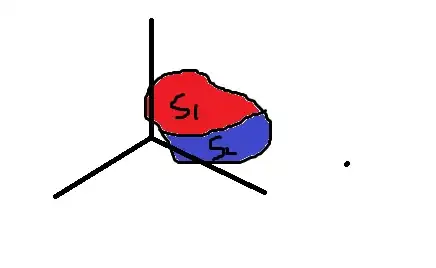
Choose $C$ to be a band across the surface, like an equator. So now you have two surfaces. So divide the surface integral into two: $$\iint\limits_{S_1}\left(\nabla\times\vec f\right)\cdot \hat n\mbox{ d}S+\iint\limits_{S_2}\left(\nabla\times\vec f\right)\cdot \hat n\mbox{ d}S$$

Since the two surfaces have opposite orientations, they cancel out (alternatively, you may use Stoke's theorem to convert them to line integrals with opposite directions). enter image description here

  • Wait, what is wrong with my formulation of the solution? Isn't a closed surface is one that has no boundary ? :O – czash Jun 22 '13 at 19:45
  • Can you please explain in a little bit more detail what do you mean by "now you have two surfaces $S_1,S_2$ ? Thanks – czash Jun 22 '13 at 19:52
  • @czash: Nothing is wrong with your solution. I was just giving another (perhaps more rigorous) solution. Bye the "2 surfaces", I mean, that when you are letting $C$, be a band across the closed surface, it cannot be a boundary to the closed surface. Instead, it works as a boundary to two different surfaces. I'll add a picture to my post to make it more clear. – Abhimanyu Pallavi Sudhir Jun 23 '13 at 02:35
  • Got it, Thanks ! – czash Jun 23 '13 at 16:19