4

The parametrized curve $$ \left( \sec\theta+\csc\theta,\ 2\sqrt{2}\csc(2\theta) \right), \qquad \frac{10}{100} \le\theta\le\frac{142}{100} $$ looks to the naked eye like a straight line. The $y$-intercept is not $0$ and the slope is a number that I haven't tried to make sense out of (yet). (The factor $2\sqrt{2}$ was chosen only to make the minimum values of the two coordinates equal to each other.) The best-fitting straight line gives all residuals less than $0.08$, quite small!

Why?

  • 2
    Wouldn't $\sec\theta$ go to $\pm\infty$ near $\pi/2$ (which is in that interval?) – Mr. G Jun 22 '13 at 23:07
  • @Mr.G : Sorry, typo: $2\sqrt{2}/\sin(2\theta)$. – Michael Hardy Jun 23 '13 at 04:00
  • Another typo: It was from $10/100$ to $142/100$. The point of course was not to get too close to the asymptotes at $0$ and $\pi/2$, so I could get a good visual impression of the graphs of the $x$- and $y$-coordinates as functions of $\theta$. – Michael Hardy Jun 23 '13 at 04:17

4 Answers4

4

Call $K=\csc\left(\theta\right)+\sec\left(\theta\right)$ and $W=a/\sin\left(2\theta\right)$ for some $a\gt0$ and $\theta\in\left]0,\pi/2\right[$ instead. You are interested in why $K$ and $W$ almost have a linear relationship. First, we know that $$K^2=\frac{1}{\sin^2\left(\theta\right)}+\frac{1}{\cos^2\left(\theta\right)}+\frac{2}{\sin\left(\theta\right)\cos\left(\theta\right)}\\=\frac{4a^2}{a^2\cdot 4\sin^2\left(\theta\right)\cos^2\left(\theta\right)}+\frac{4a}{a\cdot 2\sin\left(\theta\right)\cos\left(\theta\right)}=\frac{4W^2}{a^2}+\frac{4W}{a}\\\Longrightarrow K=\frac{2W}{a}\left(1+\frac{a}{W}\right)^{1/2}\\ \Longrightarrow \csc\left(\theta\right)+\sec\left(\theta\right)=\frac{2\sqrt{1+\sin(2\theta)}}{\sin\left(2\theta\right)}.$$ This is an exact identity. In the given interval, $\displaystyle \left|\sin\left(2\theta\right)\right| =\left|\frac{a}{W}\right|\lt 1$. We can invoke the binomial theorem: $$K=\frac{2}{\sin\left(2\theta\right)}\left[1+\frac{\sin\left(2\theta\right)}{2}-\frac{\sin^2\left(2\theta\right)}{8}+\text{higher order terms}\right]\approx \frac{2}{\sin\left(2\theta\right)}+1$$ as the other terms are going to zero. As said, this is almost a linear relationship. How good is it? Not much.

Ian Mateus
  • 7,431
  • Typo in my question: $\sin(2\theta)$ is of course in the denominator, so it has the same two asymptotes that the other function has. – Michael Hardy Jun 23 '13 at 04:13
3

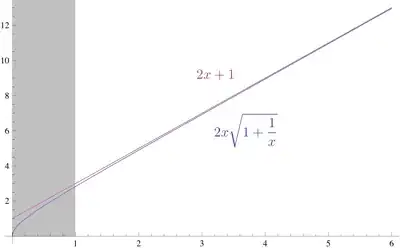
Simple trigonometric identities yield $$ (\sin(\theta)+\cos(\theta))^2=1+\sin(2\theta) $$ Taking square roots ($\sin(\theta)+\cos(\theta)$ is positive in the range considered) and multiplying by $\sec(\theta)\csc(\theta)=2\csc(2\theta)$ yields $$ \begin{align} \sec(\theta)+\csc(\theta) &=2\csc(2\theta)\sqrt{1+\frac1{\csc(2\theta)}}\\ \end{align} $$ This reduces the question to why $2x\sqrt{1+\frac1x}$ appears linear for $x\ge1$.

$\hspace{3cm}$enter image description here

Noting that $$ \left(2x+1-2x\sqrt{1+\frac1x}\right)\left(2x+1+2x\sqrt{1+\frac1x}\right)=1 $$ We see that $$ \frac1{4x+2}\le2x+1-2x\sqrt{1+\frac1x}\le\frac1{4x+1} $$ Therefore, we get $$ \sec(\theta)+\csc(\theta)=2\csc(2\theta)+1-\Delta(\theta) $$ where $$ \frac1{4\csc(\theta)+2}\le\Delta(\theta)\le\frac1{4\csc(\theta)+1} $$

robjohn
  • 345,667
1

$\displaystyle{ \frac{\mathrm{d}y}{\mathrm{d}x}= {{\frac{\mathrm{d}y}{\mathrm{d}\theta}}\over{\frac{\mathrm{d}x}{\mathrm{d}\theta}}}=\frac{4\sqrt{2}\cos{2\theta}}{\sec{\theta}\tan{\theta}-\cot\theta\csc\theta}}$ which happens to not vary much in the given interval.

Any smooth curve will look straight if it is zoomed into far enough.

  • But it's a pretty long interval! I stayed away from the vertical asymptotes in order to facilitate plotting each of the two coordinates as a function of $\theta$. I included most of the space between. – Michael Hardy Jun 23 '13 at 03:40
  • Typo in my question: $\sin(2\theta)$ is of course in the denominator, so it has the same two asymptotes that the other function has. – Michael Hardy Jun 23 '13 at 04:03
1

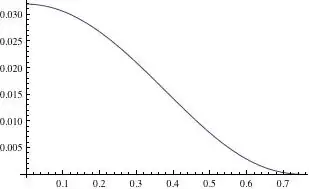
Put $\theta:={\pi\over4}+t$. Then we have the curve $$\gamma:\quad t\mapsto {\bf z}(t)=\bigl (x(t),y(t)\bigr):=\left({\cos t\over\cos(2t)},{1\over\cos(2t)}\right)\qquad \left(-{\pi\over4}<t<{\pi\over4}\right)$$ which is actually the same curve back and forth with a "Rückkehrpunkt" at ${\bf z}(0)=(1,1)$. The curvature of $\gamma$ can be computed as $$\kappa(t)={x'(t)y''(t)-x''(t)y'(t)\over\bigl(x'^2(t)+y'^2(t)\bigr)^{3/2}}\ .$$ Here is a plot of $t\mapsto\kappa(t)$. It shows that the curvature is maximal ($={4\over125}=0.032$) at the "Rückkehrpunkt".

enter image description here