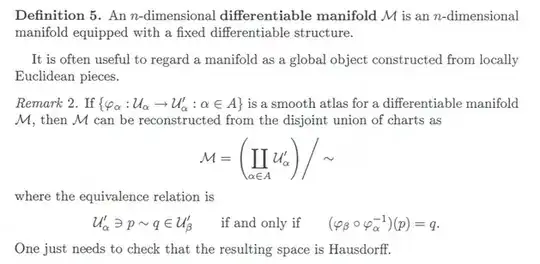
In the notes above, I am not quite sure what the up-side-down $\Pi$ is, nor the notation of $/ \sim$.
$\amalg$ means disjoint union as Peter Tamaroff advised.
As for the notation of$/ \sim$, I guess it means take away subsets in the manifold that are mapped for multiple times? Therefore, each element in the manifold is covered by a coordinate chart exactly once, hence is disjoint?
What does it mean by "One just need to check the resulting space is Hausdorf" at the end?
The reason it mentions Hausdorff at the end of the remark is because the definition of manifold:
A second-countable Hausdorff space $\mathcal{X}$ is an $n$-dimensional (abstract) manifold if for every $p \in \mathcal{X}$ there exists a neighborhood $\mathcal{U}$ and a homeomorphism $\varphi: \mathcal{U} \rightarrow \mathcal{U}^\prime$ to an open set $\mathcal{U}^\prime \rightarrow \mathbb{R}^n$.

