3

This is real life calling.

My parents own a piece of property in which we would like to divide equally in two parts. There are two buildings on the property - an old house (H) from 1935 and an annex (A) to it's west side. I need a way to calculate this correctly, the trial-and-error ways of doing it have not yielded results my geeky nature will accept easily (I'm always off by at least one square meter).

The division must take into account that we cannot cut through any of the buildings but rather have to draw the division line (x) at the line where the buildings touch each other, then divide the rest of the property from the endpoint of that line on so that in the end we have two equal parts in size.
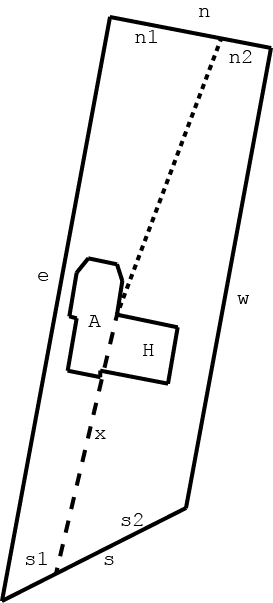
The property seen from above

(x) in this picture is parallel to e, this is just my bad drawing skills.

The variables I see here are: n,s,e,w as the length of the sides of the property. x as the length of the straight line between the buildings. s1,s2 as the lengths of the lines at which the divison line x starts. The result should show the length of n1,n2 as where the angled, calculated division line will meet n.

As I am quite at lost here I was hoping for your help. Thank you!

Christian
  • 133
  • 1
    In calculating the area of each of the two pieces of property, are the areas of the buildings to be included? That is, does the area of part $1$ include $A$, and the area of part $2$ include $H$? – Zev Chonoles Jun 24 '13 at 08:33
  • 1
    Actually, aren't there two corners where the houses meet since the frontier is a line? I only see you use one corner in the drawing. – Raskolnikov Jun 24 '13 at 08:41
  • @ZevChonoles Yes, the area of the house and of the annex are part of the area of the respective property. – Christian Jun 24 '13 at 08:44
  • 1
    @Raskolnikov The house meets the annex along a straight line (the line between A and H. x is just that line "prolonged" until it meets s. (I hope I understood your question) – Christian Jun 24 '13 at 08:45
  • OK, but if you alter $s_1$ you are going to cut either through house A or through house H. That's why I don't understand your drawing. – Raskolnikov Jun 24 '13 at 08:48
  • @Raskolnikov: I think the only intended variable of the problem is the location of the point dividing line $n$ into $n_1$ and $n_2$. – Zev Chonoles Jun 24 '13 at 08:51
  • @Zev: That would make sense. We'd need to know the distance from the corner to side n and side e then to give an analytic answer. I presume the backyard is just a rectangle. EDIT: Actually, n2=d(e,corner) then. – Raskolnikov Jun 24 '13 at 08:53
  • @ZevChonoles Correct. The lengths of x,n,e,w are known, as are s1 and s2 (s=s1+s2). – Christian Jun 24 '13 at 09:41
  • We need to know the position of the corner. – Raskolnikov Jun 24 '13 at 10:32
  • @Raskolnikov Which corner? What units (ie. would you like to have an absolute coordinate or just the length of a certain variable)? – Christian Jun 24 '13 at 12:06
  • Where the dotted lines meet, not necessarily absolute, at least relative to n and e. – Raskolnikov Jun 25 '13 at 06:29
  • @Raskolnikov Well, x is parallel to e, starts at a distance of s1 from e. I don't really have that as an absolute coordinate, all I have is the lengths of n,s,w,e,s1,s2,x... – Christian Jun 25 '13 at 06:41

1 Answers1

2

OK, here's the solution. The distance of the corner (that is the point where the dotted lines meet) to the side $e$ is $n\frac{s_1}{s}$, while to the side $w$ it is $n\frac{s_2}{s}$. Also, $e-w=\sqrt{s^2-n^2}$ by the Pythagorean theorem.

This allows us to compute the surface of four trapezia determined by that corner and the corners of the entire terrain. The area of the bottom left trapezium is

$$s_1\frac{n}{s}\left(x+\frac{s_1}{2s}(e-w)\right) \; .$$

The area of the bottom right trapezium is

$$s_2\frac{n}{s}\left(x-\frac{s_2}{2s}(e-w)\right) \; .$$

The area of the top left trapezium is

$$\frac{1}{2}\left(e-x-\frac{s_1}{s}(e-w)\right)\left(n_1+s_1\frac{n}{s}\right) \; .$$

Finally, the area of the top right trapezium is

$$\frac{1}{2}\left(w-x+\frac{s_2}{s}(e-w)\right)\left(n_2+s_2\frac{n}{s}\right) \; .$$

Our condition is that the sum of the left areas equals the sum of the right areas. This gives after some algebra the following relation

$$x\frac{s_1-s_2}{s}+\frac{s_1^2+s_2^2}{2s^2}(e-w)=\frac{1}{2}\left(\frac{es_1+ws_2}{s}-x\right)\left(\frac{n_2-n_1}{n}+\frac{s_2-s_1}{s}\right) \; .$$

Raskolnikov
  • 16,108
  • Cool Stuff. Now, it's probably me being just stupid here, but how do I solve this for n1 and n2? Those are the values I'll need in the end... – Christian Jun 25 '13 at 08:28
  • As you can see, you can solve for the relative difference $(n_2-n_1)/n$. But since you know the length $n=n_1+n_2$, that's all you need to know to find $n_1$ and $n_2$. – Raskolnikov Jun 25 '13 at 08:30