0

Image alt text

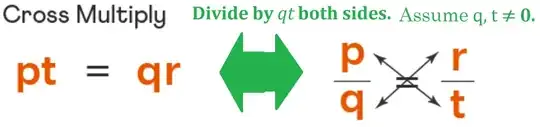
I already know, I'm NOT asking about, the algebra. It's NOT intuitive why 3 pears x 4 tangelos = 6 quinces x 2 riberries $\iff$ 3 pears/6 quinces = 2 riberries/4 tangelos.

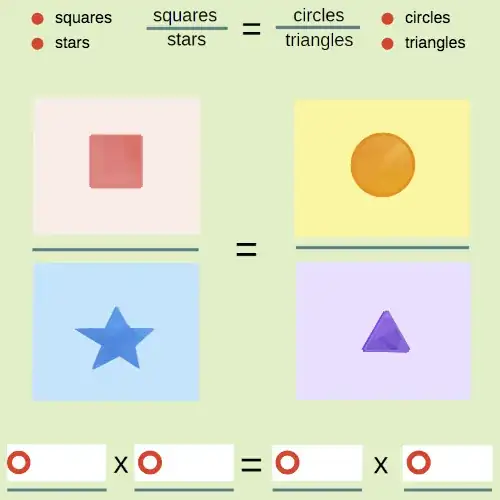
I stumbled the picture below, but how does it proffer intuition?
  • 1
    I think the intuition comes from multiplying the numerator and denominator:$$\frac{p}{q}=\frac{r}{t} \iff \frac{pt}{qt}=\frac{rq}{tq} \iff pt=qr$$ – Joe Nov 29 '21 at 17:34
  • 3
    I'm not sure this actually has the sort of intuitive explanation you're hoping for (and FWIW I think the picture you've asked about is indeed totally unhelpful). For me personally, cross multiplication was one of the moments where algebraic intuition started to become a distinct thing in its own right: the intuitive explanation for me was "doing the same thing to equivalent things results in equivalent things," and it's around this time that I stopped thinking of multiplication in terms of real-world operations (although that could just be a developmental coincidence). – Noah Schweber Nov 29 '21 at 17:36
  • 3
    It might be more intuitive if you pick some units that often go together, instead of fruit. For example, suppose $p$ and $q$ are speeds and $t$ and $r$ are times. Then the left-hand side $p t = q r$ says the distances travelled are the same, and the right-hand side $\frac{p}{q} = \frac{r}{t}$ says that the factor by which one person was faster is the same as the factor of how much longer the other person spent travelling. – Jakob Streipel Nov 29 '21 at 17:37
  • 1
    Related: https://math.stackexchange.com/questions/2667040/explaining-why-cross-multiplication-works-using-a-pie – Bonnaduck Nov 29 '21 at 17:42
  • If you want a geometric intuition, you could draw two rectangles side by side, both with length $q$ and height $t$. Shade $p/q$ of the first rectangle by dividing the length into two parts of lengths $p$ and $q-p$. Shade $r/t$ of the second rectangle by dividing the width into two parts of lengths $r$ and $t-r$. The fraction of shaded region is the same when the area of the two shaded regions are the same: $pt=qr$. – Joe Nov 29 '21 at 17:58
  • It seems that this is a question about interpretation of units, not intuition for algebra. Without units, this is obvious. With units, it's a little more unclear why this should hold. It might be more informative to ask this in a physics forum. – While I Am Nov 29 '21 at 18:03
  • 1
    For reference, at that website, it explains that there are actually multiple shapes on top of each other, and that the user needs to unstack them to see the actual equation, which when I did it was $2/3=4/6$. I still don't think it's a helpful visual, but it makes more sense than the version you posted. – Joe Nov 29 '21 at 18:12

0 Answers0