0

I am calculating the area of a retaining wall which goes from above the finished surface level to below it. Seen below
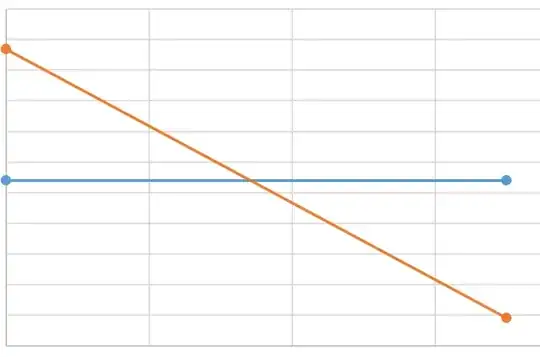
Retaining Wall

I only have the two points on either end of the wall and the distance between them. How do I use these in an excel formula to calculate the total area. If I wanted to I could create a point in between them and calculate the distance at which it crosses through zero. But is there a quicker way to calculate the area, using just one formula?

If both values are positive. simply, you can obtain the average height of wall and multiply by the distance, but this fails for this case. Please any help would be great.

Andrei
  • 37,370
  • You are just showing a line, not an area. I assume that you know a distance in the direction perpendicular to the figure. What exactly do you want to compute? Is it the distance from the intersection of the lines to one end? – Andrei Feb 21 '22 at 03:13
  • I want to calculate the area of the retaining wall, which would be the area in between the orange and blue lines, from the point on the left to the right. This is just an example, with no values as I want to be able to use a single excel formula to calculate any values for this case. – S. Strevens Feb 21 '22 at 03:34
  • So you want the sum of the area of the two triangles? – Andrei Feb 21 '22 at 03:39
  • Yep that's it. I could do it manually for sure. But by using one excel cell, and only the y and x values for each of those four points shown. – S. Strevens Feb 21 '22 at 03:58

1 Answers1

1

Let's use the indices $1L$ and $1R$ for the blue line, and $2L$ and $2R$ for the orange line. Then the basis of the left triangle is $y_{2L}-y_{1L}$, and the basis of the right triangle is $y_{1R}-y_{2R}$. The heights of the two triangles are $x_i-x_L$ and $x_R-x_i$, where $i$ denotes the intersection. You know $$(x_R-x_i)+(x_i-x_L)=x_R-x_L\\\frac{x_R-x_i}{x_i-x_L}=\frac{y_{1R}-y_{2R}}{y_{2L}-y_{1L}}$$ You can then write $$x_i-x_L=\frac{x_R-x_L}{1+\frac{y_{1R}-y_{2R}}{y_{2L}-y_{1L}}}=\frac{(y_{2L}-y_{1L})(x_R-x_L)}{(y_{2L}-y_{1L})+(y_{1R}-y_{2R})}$$and $$x_R-x_i=\frac{(y_{1R}-y_{2R})(x_R-x_L)}{(y_{2L}-y_{1L})+(y_{1R}-y_{2R})}$$ Then the total area is: $$\frac12\frac{[(y_{2L}-y_{1L})^2+(y_{1R}-y_{2R})^2](x_R-x_L)}{(y_{2L}-y_{1L})+(y_{1R}-y_{2R})}$$

Andrei
  • 37,370