1

About a 4x4 Rubik's cube. We know the count of permutations.

But how about the permutation of the centers only ?

X X X X
X O O X
X O O X
X X X X

There are 6 colored faces containing 4 stickers at centers (marked with "O"). How many permutations do we have ? This is 24 facelets but the answser is not 24! because when we have placed 5 faces, the last face is obviously made with the 4 last facelets of the same color.

How could we calculate the number of the centers position ?

JeffProd
  • 111
  • It is possible to do a lot of 3-cycles involving center facelets alone. I haven't written all the details down, but I'm fairly sure that all the even permutations of the 24 facelets are possible, so the number of permutations is $\dfrac12,24!$. – Jyrki Lahtonen Feb 21 '22 at 15:45
  • 1
    If the centre pieces are distinguishable, then it is $\frac{24!}{2}$ as @JyrkiLahtonen writes. If you consider them to be six sets of indistinguishable pieces, then it's $\frac{24!}{4!^6}$. All this is assuming that the cube has a fixed orientation in space, e.g. by using one of the corner pieces as a reference. – Jaap Scherphuis Feb 21 '22 at 15:48
  • The 2x2 permutation is "only" 3,674,160 (https://en.wikipedia.org/wiki/Pocket_Cube) This is about the corners pieces. So I am surprised of the so big number 24! – JeffProd Feb 21 '22 at 15:52

1 Answers1

1

Posting this to get something started.

Using the counting convention described in Jaap's comment it can be shown that we can get all the even permutations of the 24 facelets, giving a total of $$ \dfrac12\,24!=310224200866619719680000 $$ ways of positioning them.

It is well known that all the 3-cycles generate the group of all even permutations. It is easy to milk more out of the idea and show that a handful of 3-cycles will suffice (we can use conjugation to get more of them). The key is thus to show that enough 3-cycles can be realized by sequences of moves. The animation below shows one such.
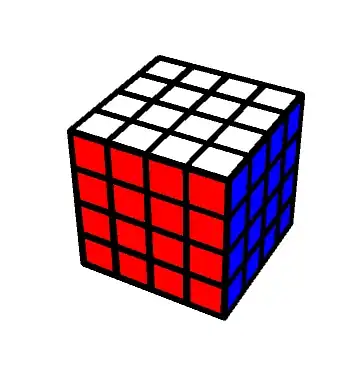
enter image description here

The visual appearance is a bit deceiving in that it may look as if only a single white sticker and a single blue sticker trade places. If you look at it more closely you will see that actually they move in a 3-cycle White->White->Blue (->White). In other words: the net effect of this sequence is that white facelet A moves to the place of the white facelet B that moves to the blue area, and a blue facelet moves to the place where the white facelet A was before the beginning of the sequence.

Jyrki Lahtonen
  • 133,153
  • You may also see how the sequence is actually a commutator of two very short sequences. Ask, if you want to know more about such details. – Jyrki Lahtonen Feb 21 '22 at 16:20
  • A different kind of a 3-cycle is discussed here. I would generate it by composing the sequence above with another 3-cycle gotten by conjugating this sequence with a 90 degree rotation of the top layer. – Jyrki Lahtonen Feb 21 '22 at 16:24
  • One way of describing the 3-cycle here is to look at position on the front (red) face, second row from the bottom, second column from the right. That is where the action is really taking place. The named threee facelets take turns visiting that place. The rest of the action gets cancelled in the commutator. – Jyrki Lahtonen Feb 21 '22 at 16:35
  • The animation shows the way to 3-cycle two white center facelets and one facelet of a color other than white (or the color on the opposite side of white, here yellow). Conjugating such a 3-cycle by another similar 3-cycle involviing the same two whie facelets and a third facelet of a different color then yields 3-cycles involving facelets of pairwise distinct colors. Together with those given in the linked thread we are done. Actually the 3-cycles involving three white facelets can be gotten as a composition of two 3-cycles of the animated type. – Jyrki Lahtonen Feb 27 '22 at 06:23