Introduction: I will use the parameter $x=\widehat{ABD}$ instead of the variable $a$ that appears in the comment of Ivan Kaznacheyeu.
It turns out that it is convenient to use also
$$
y := 30^\circ-2x\ .
$$
We try thus to show in a geometrical way a geometrical substitute for the trigonometric identity (Ceva):
$$
\begin{aligned}
1
&=
\frac{\sin 2y}{\sin (30^\circ+x)}\cdot
\frac{\sin x}{\sin y}\cdot
\frac{\sin (60^\circ+x)}{\sin 3x}\ ,
\\[3mm]
&
\qquad\text{ with the given particular form for $x=5^\circ$, $x=20^\circ$ :}
\\[3mm]
1
&=
\frac{\sin 40^\circ}{\sin \color{red}{35^\circ}}\cdot
\frac{\sin 5^\circ}{\sin 20^\circ}\cdot
\frac{\sin 65^\circ}{\sin \color{red}{15^\circ}}\ .
\end{aligned}
$$
The three fractions correspond to proportions of the sine values, as they appear in the first picture in the posted question. The problem is to find (geometrically) two angles (maybe like $\color{red}{35^\circ}$ and $\color{red}{15^\circ}$) adding to
$50^\circ$ and making the corresponding product equal to one.
Note that exchanging the red values, we obtain again a solution!
So it is enough to show geometrically that (either) one of the two configurations of points is valid.
If we are already using this argument, then why not also permute the factors in the numerator, so that the new obtained configuration of angles comes with a better situation / symmetry. I will show instead geometrically:
$$
\begin{aligned}
1
&=
\frac{\sin 2y}{\sin (30^\circ+x)}\cdot
\frac{\sin x}{\sin 3x}\cdot
\frac{\sin (60^\circ+x)}{\sin y}\ ,
\\[3mm]
&
\qquad\text{ with the given particular form for $x=5^\circ$, $y=20^\circ$ :}
\\[3mm]
1
&=
\frac{\sin 40^\circ}{\sin \color{red}{35^\circ}}\cdot
\frac{\sin 5^\circ}{\sin \color{red}{15^\circ}}\cdot
\frac{\sin 65^\circ}{\sin 20^\circ}\ .
\end{aligned}
$$
For such changes there is also a simple geometric argument.
Exchanging numerator and denominator corresponds to passing from one intersection point of cevians to its isogonal conjugate. Else, permutations are generated by transpositions. (Below we use in fact only a transposition.) For a transposition of angles, like passing from a triangle $\Delta ABC$ and cevians for the tuple $(\color{blue}{x},x';\color{red}{y},y';z,z')$, where $\hat A=x+x'$, $\hat B=y+y'$ , $\hat C=z+z'$ to a cousin triangle with cevians for the tuple $(\color{red}{y},x';\color{blue}{x},y';z,z')$ we have the following simple observation:
Observation:
Let $\Delta ABC$ be a triangle, let $S$ be a(n interior) point such that we have the following angle separation determined by the cevians $AS$, $BS$, $CS$:
$$
\hat A=x+x'\ , \ \hat B=y+y'\ ,\ \hat C=z+z'\ .
$$
Denote such a configuration of cevians by $(\color{blue}{x},x';\color{red}{y},y';z,z')$. Consider an other triangle, determined up to similarity, with three cevians realizing the separation of angles for the tuple $(\color{red}{y},x';\color{blue}{x},y';z,z')$. Then these cevians are also concurrent.
Picture proof: Let $A'\in AC$ be such through $BA'$ is building the angle $x$ with $BD$. Then $ABDA'$ is cyclic. So $\widehat {BA'D}=\widehat {BAD}=x'$.
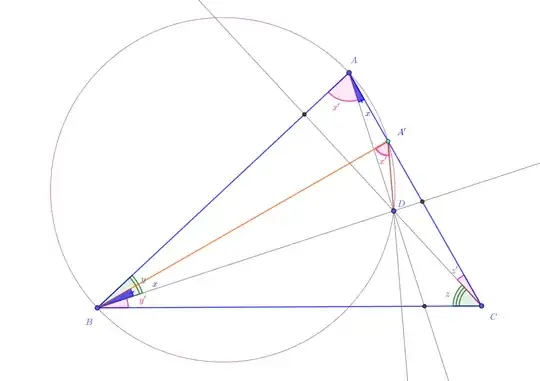
Use the one "other triangle" $\Delta A'BC$ realizing the tuple $(y,x';x,y';z,z')$ with cevians $A'D$, $BD$, $CD$ concurrent in the same point $D$ to conclude.
$\square$
After this introduction we are in position to start the answer.
Claims and Proofs:
Our task explicity is to show the following:
Proposition:
Let $x$ be an angle between $0^\circ$ and $15^\circ$. Denote by $y$ the angle $y=30^\circ-2x$. Consider the triangle $\Delta ABC$ with angles $90^\circ-3x$ in $A$, and $4x$ in $B$, and $90^\circ-x$ in $C$. Draw three cevians as in the picture, that separate the angles as follows:
- in $A$: $90^\circ-3x=2y+(30^\circ+x)$,
- in $B$: $4x=x+3x$,
- in $C$: $90^\circ-x=(60^\circ+x)+y$.
Then the three cevians are concurrent in a point $D$.
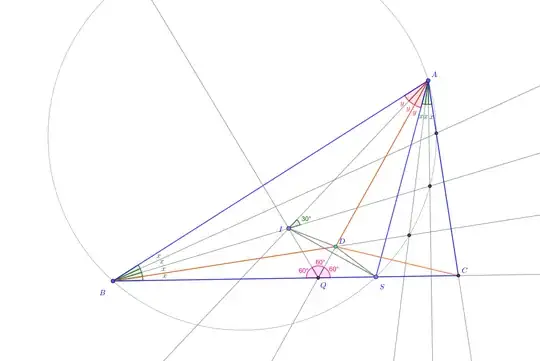
Notes: In the picture, $Q:=AD\cap BC$, $I$ is the incenter in $\Delta ABQ$,
the marked angle in $I$, exterior to $\Delta IAB$ has measure $2x+y=30^\circ$,
and the marked angles in $Q$ follow because $IQ$ is the third angle bisector through $I$, and we know the angle in $Q$ exterior to $\Delta QAB$ with measure $4x+2y=2(2x+y)=60^\circ$.
It is because of realizing the angles $3y$ in $A$ and $4x$ in $B$ why i was choosing to state and proof this variation, among the many other obtained by the one or other permutation of angles.
For the proof of the proposition, we show first the following Lemma, which isolate a part of the figure.
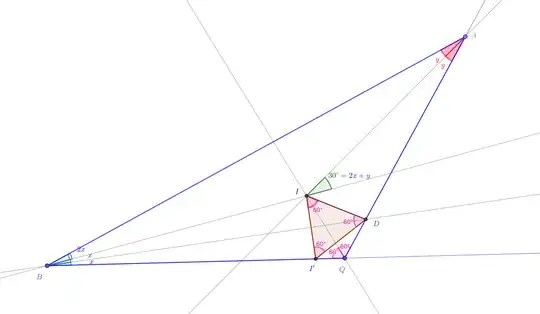
Lemma: Let $x,y$ be angles as above, $2x+y=30^\circ$. Consider a triangle $\Delta ABQ$ with angles $2y$ in $A$, $4x$ in $B$, and the rest of $180^\circ - 2(2x+y)=2\cdot 60^\circ$ in $Q$. Let $I$ be its incenter. Reflect $I$ w.r.t. angle bisector of $\widehat{IBQ}$ in a point $I'\in BQ$.
Construct the equilateral triangle $II'D$. (Here $B$ and $D$ are in different half-planes w.r.t. the bisector $AI$ of $\hat A$.) Then $D\in AQ$.
Proof of the Lemma:
The quadrilateral $II'QD$ is cyclic because of $\hat I+\hat Q=60^\circ + 2\cdot 60^\circ=180^\circ$. Then:
$$
\widehat{IQD} =
\widehat{II'D} =
60^\circ=
\widehat{IQA}\ .
$$
So $QD$, $QA$ build the same angle w.r.t. the reference line $IQ$.
$\square$
Corollary: Let $ABQ$ be the triangle from the above Lemma. Then the angle bisector of $\widehat{IBQ}$ intersects $AQ$ in a point $D$ with
$\widehat{IDB} = 30^\circ$.
$\square$
We are now in the position to conclude:
Proof of the Proposition:
Define $D$ rather as the intersection of the cevians from $A$ and $B$.
(We show $D$ is on the cevian from $C$ from the Proposition.)
We compare $\Delta IAQ$ and $\Delta SAQ$, so
$S$ is the reflection of $I$ w.r.t. $AQ$.
From the Corrolary, we know the angle $\widehat{IDB}=30^\circ$ in the picture:
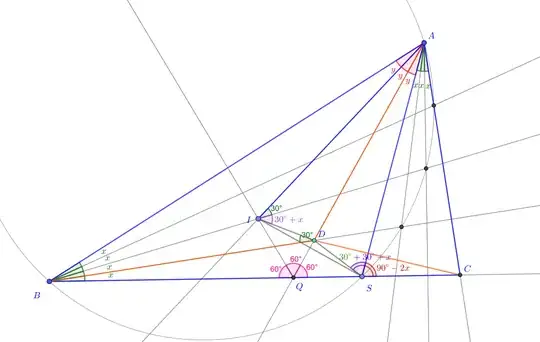
From this, we can compute all angles around $S$. We need:
$$
\begin{aligned}
\widehat{ASC} &= 180^\circ-\hat A-\hat C=180^\circ - 3x - (90^\circ-x)=2x\text{ in }\Delta ASC\ ,\\
\widehat{ASD} &=
\widehat{AID} = 30^\circ + (30^\circ+x)=60^\circ +x\ ,\\
\widehat{DSB} &=
180^\circ - \widehat{ASC}-\widehat{DSA}
\\
&=30^\circ+x=y+3x
\\
&=\widehat{DAC}\ .
\\[3mm]
&\qquad\text{ So $ADSC$ is cyclic, giving }
\\[3mm]
\widehat{DCS} &= \widehat{DAS} =y\ .
\end{aligned}
$$
So the cevian $CD$ separates $C$ in the angles $y$ and $(60^\circ+x)$, what we wanted to show.
$\square$


