There are certain ambiguities in what are the sides and radius of a rounded polygon.
I will assume you start from a simple polygon and use circular arcs of a specific radius $r$ to smooth out the corners.
Let
- $A_r$ and $L_r$ be the area and perimeter of such a rounded polygon.
- $\theta_i$ be the $i^{th}$ external angle (negative when internal angle $> 180^\circ$).
When $r$ is small enough, the circular arcs don't overlap. In this case, you can work out contribution from individual corner and sum the result. The end result is
$$A_r = A_0 - r^2 \sum\limits_i\left( \tan\frac{\theta_i}{2} - \frac{\theta_i}{2}\right)\quad\text{ and }\quad
L_r = L_0 - 2r\sum\limits_i\left|\tan\frac{\theta_i}{2} - \frac{\theta_i}{2}\right|$$
In general, $\sum\limits_i \theta_i = 2\pi$ for any simple polygon. If the initial polygon is convex, then all $\theta_i > 0$. Above formula reduces to
$$\begin{cases}
A_r &= A_0 - r^2(\lambda - \pi)\\
L_r &= L_0 - 2r(\lambda - \pi)
\end{cases}
\quad\text{ with }\quad
\lambda = \sum\limits_i \tan\frac{\theta_i}{2}.$$
If the initial polygon is an equiangular $n$-gon (ie. all external angles $\theta_i$ equal to $\frac{2\pi}{n}$), then $\lambda = n\tan\frac{\pi}{n}$.
In particular, square and rectangles are equiangular $4$-gon. For them $\lambda = 4\tan\frac{\pi}{4} = 4$ and this reproduces the formula you already knew.
Update
I was surprised I can't find a derivation of this simple result online.
In any event, following is a picture illustrating the formula:
$\hspace 0.5in$ 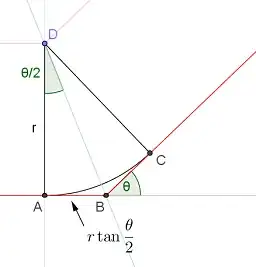
As one can see, the area reduction at a rounded corner $A$ (the polygon occupies the region above the two red lines) is the area of the
curved triangle $ABC$. It in turn equals to the difference of areas of the kite $ABCD$ ( $r^2\tan\frac{\theta}{2}$ ) and the circular sector $DAC$ ($r^2\frac{\theta}{2}$).

