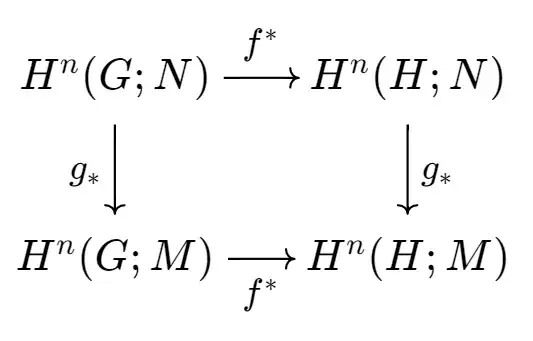
Yes.
Let's note $H_n$ the $n$th element of the chain complex of $H$ (not to be confused with homology groups). Similarly we note $G_n$ the $n$th chain element of $G$'s complex.
Recall that the chain complex of $G$ is a sequence of maps between (what I assumme you are dealing with) modules over some ring. $\cdots\to G_n\to G_{n-1}\to\cdots \to G_1\to G_0 \to 0$. And similarly with $H$.
From the map $f:H\to G$ the construction of an induced $f_n:H_n\to G_n$ for each $n$ is done in a standard way in any homology text. Such maps induce a pre-composition on the hom-sets $f^*:\hom(G_n,N)\to \hom(H_n,N)$ and the same is true if we replace $N$ by $M$.
An homomorphism $g:N\to M$ induces a post composition $g_*:\hom(H_n,N)\to\hom(H_n,M)$ as well. Explicitly, the maps are:
$$\hom(G_n,N)\xrightarrow[]{f^*}\hom(H_n,N)\xrightarrow[]{g_*}\hom(H_n,M)$$
$$\phi \mapsto \phi f \mapsto g \phi f$$
An important fact about this maps is that they commute in the sense that $f^*g_*=g_*f^*$. It should be easy to check this.
Recall that co-homology is obtained by computing successive "kernell over image" on the co-chain sequences
$$0\to \hom(G_0,M) \to \hom(G_1,M) \to \hom(G_2,M) \to \cdots$$
and similarly replacing one of $N$ by $M$ or $G$ by $H$.
Let us note from now on $[A,B]=\hom(A,B)$
We have thusly co-chain complex maps that assemble into a diagram
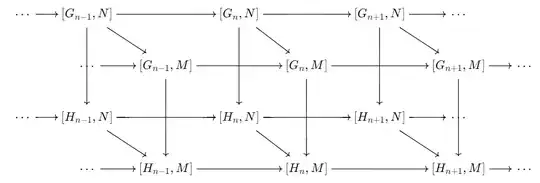
where downward arrows are $f_*$, righward arrows are the "co-border" morphisms from the co-chain sequence and diagonal arrows are $g_*$
Using the important fact we get that some squares are commutative Which ones?. Also, the standard (natural) construction $f_*$ makes it conmute with co-border maps so front and back squares conmute. Even more, you should check that $g_*$'s conmute with co-borders, this being true because co-borders are just pre composition by border homomorphisms, so you get commutativity of top and bottom squares. This is enough to make the whole diagram commutative. I suggest drawing it on paper, putting all the names to the arrows and giving it some thought.
Now, applying co-homology to the diagram, co-chain complex homomorphisms $f^*:([G_n,N])_{n\geq 0}\to ([H_n,N])_{n\geq 0}$ (resp. $M$) and $g_*:([G_n,N])_{n\geq 0}\to ([G_n,M])_{n\geq 0}$ (resp. $H$) give rise to co-homology sequence homomorphisms between co-homology groups in a natural way, this meaning that commutativity is preserved since co-homology is functorial. That commutativity is preserved means you get the desired commutative square: