An obvious solution is $x=0$.
If $a=6$ , $b=2$ , $c=7\quad$ a second solution is $x=1$.
If $a\simeq 6$ , $b\simeq 2$ , $c\simeq 7\quad$ the shape of the curve
$$y(x)=a^x+b^x-c^x$$
is of this kind :
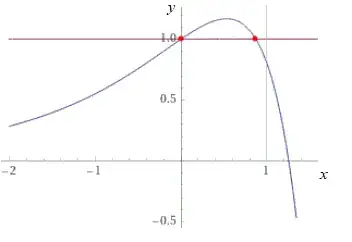
The second solution is close to $x\simeq 1$ and has to be computed thanks to numerical calculus with given numerical values of $a,b,c.$
A first approximate can be computed thanks to serie expansion of :
$$a=6+\epsilon_1$$
$$b=2+\epsilon_2$$
$$c=7+\epsilon_3$$
$$x=1+\epsilon$$
From the fist term of the series expension of
$$(6+\epsilon_1)^{1+\epsilon}+(2+\epsilon_2)^{1+\epsilon}-(7+\epsilon_3)^{1+\epsilon}=1$$
one get :
$$x\simeq 1-\frac{\epsilon_1+\epsilon_2-\epsilon_3}{6\ln(6)+2\ln(2)-7\ln(7)}$$
For example with $a=6.2$ , $b=1.9$ , $c=7.3$ :
$$x\simeq 0.865276\quad;\quad a^x+b^x+c^x\simeq 1.006577$$
Comparing to the solution obtained with numerical nonlinear equation solving (Wolfram Alpha) :
$$x\simeq 0.870988\quad;\quad a^x+b^x+c^x\simeq 0.9999997$$
DETAILS OF THE SERIES EXPANSIONS (answer to a request in comments).
$$(6+\epsilon_1)^{1+\epsilon}=\exp\big((1+\epsilon)(\ln(6+\epsilon_1) \big)$$
$$(1+\epsilon)\ln(6+\epsilon_1)=(1+\epsilon)\left(\ln(6)+\ln(1+\frac{\epsilon_1}{6})\right)$$
In order to simplify the writting, the terms of second order such as $(\epsilon_1)^2$ or such as $(\epsilon_1\epsilon)$ are neglected. Each time they are replaced by ...
$$(1+\epsilon)\ln(6+\epsilon_1) \simeq (1+\epsilon)\left(\ln(6)+\frac{\epsilon_1}{6}+...\right)$$
$$(1+\epsilon)\ln(6+\epsilon_1) \simeq \ln(6)+\frac{\epsilon_1}{6} +\epsilon \ln(6)+...$$
$$\exp\big((1+\epsilon)\ln(6+\epsilon_1)\big) \simeq 6\exp\left(\frac{\epsilon_1}{6} +\epsilon \ln(6)+... \right)$$
$$\exp\big((1+\epsilon)\ln(6+\epsilon_1)\big) \simeq 6\left(1+\frac{\epsilon_1}{6} +\epsilon \ln(6)\right)+...$$
$$\exp\big((1+\epsilon)\ln(6+\epsilon_1)\big) \simeq 6+\epsilon_1 +6\,\epsilon \ln(6)+...$$
The same for the other terms :
$$\exp\big((1+\epsilon)\ln(2+\epsilon_2)\big) \simeq 2+\epsilon_2 +2\,\epsilon \ln(2)+...$$
$$\exp\big((1+\epsilon)\ln(7+\epsilon_3)\big) \simeq 7+\epsilon_3 +7\,\epsilon \ln(7)+...$$
Putting them into
$$(6+\epsilon_1)^{1+\epsilon}+(2+\epsilon_2)^{1+\epsilon}-(7+\epsilon_3)^{1+\epsilon}=1$$
leads to
$$6+\epsilon_1 +6\,\epsilon \ln(6)+2+\epsilon_2 +2\,\epsilon \ln(2)-7-\epsilon_3 -7\,\epsilon \ln(7)+...\simeq 1$$
$$\epsilon_1 +6\,\epsilon \ln(6)+\epsilon_2 +2\,\epsilon \ln(2)-\epsilon_3 -7\,\epsilon \ln(7)+...\simeq 0$$
Solving for $\epsilon$ :
$$\epsilon\simeq-\frac{\epsilon_1+\epsilon_2-\epsilon_3}{6\ln(6)+2\ln(2)-7\ln(7)}$$


