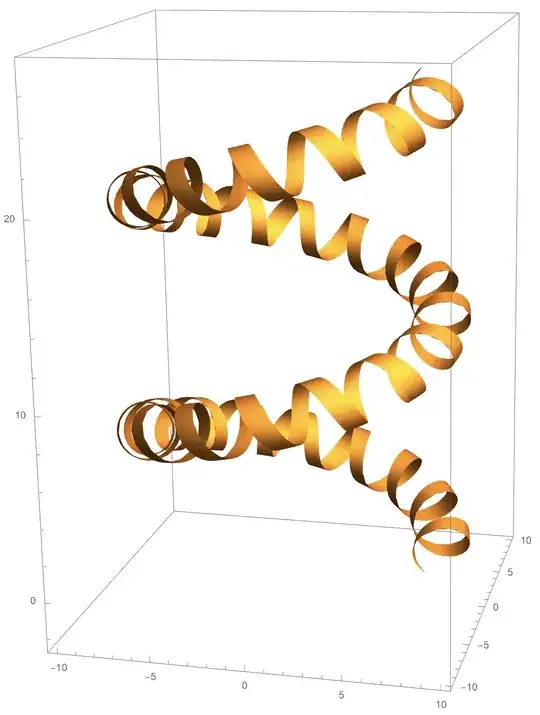
The correct way to generalize the given parametrization is
$$\begin{align}
x(t,u) &= (R + a \cos (\omega t + u)) \cos t \\
y(t,u) &= (R + a \cos (\omega t + u)) \sin t \\
z(t,u) &= h t + a \sin (\omega t + u).
\end{align}$$
$R$ controls the turning radius of the primary helical structure; $a$ is the radius of the winding of the surface around the primary helix--i.e., it is a "secondary" helical radius. Then $\omega$ is the frequency of windings for each full rotation around the primary helix, and $h$ is the vertical period for each full rotation. The parameter $t$ corresponds to the total angular rotations around the primary helix, an $u$ is a parameter that controls the width of the ribbon.
The following plot corresponds to the choices $$(R, a, \omega, h) = (8, 1.5, 15, 2),$$ for the parameter ranges $t \in [0, 4\pi]$ and $u \in [-1,1]$:
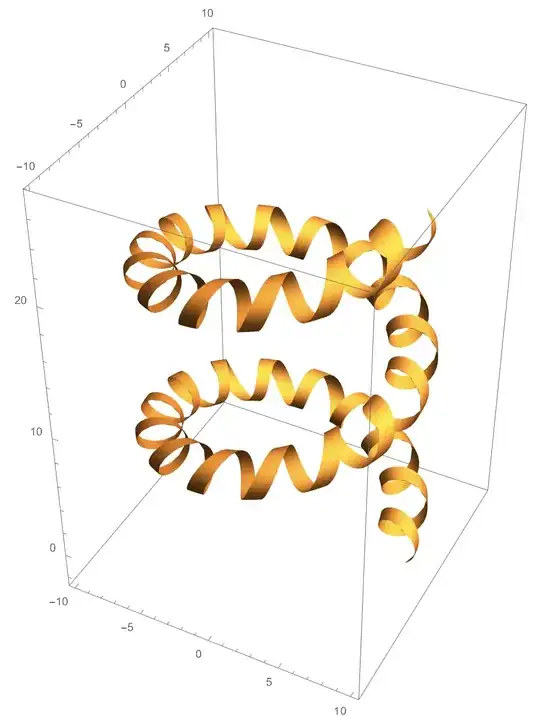
The drawback to this parametrization is that the orientation of the ribbon as it winds around the primary helix is not perpendicular to the tangent vector of the helix. You can see this in certain areas of the plot: the ribbon is sort of "warped." In order to correct this, you would need a much more complicated parametrization of a helical tube. For example,
$$\begin{align}
x(t,u) &= R \cos t - a \cos t \sin (\omega t + u) + \frac {h a \sin t \sin (\omega t + u)}{\sqrt{R^2 + h^2}} \\
y(t,u) &= R \sin t - a \sin t \cos (\omega t + u) + \frac{h a \cos t \sin (\omega t + u)}{\sqrt{R^2 + h^2}} \\
z(t,u) &= h t + \frac{R a \sin (\omega t + u)}{\sqrt{R^2 + h^2}}
\end{align}$$
for the same choices, yields a more pleasing result: