1

Solve for all complex $x$ such that $\sin(x)^{\cos(x)} = 2$ using Lambert W function .

I'd just encountered the question in the series after that of $$\sin(x)^{\sin(x)} = 2$$ where Lambert W function was used giving some complex solutions of $x$ and was wondering if there were any similar way to solve the above problem.

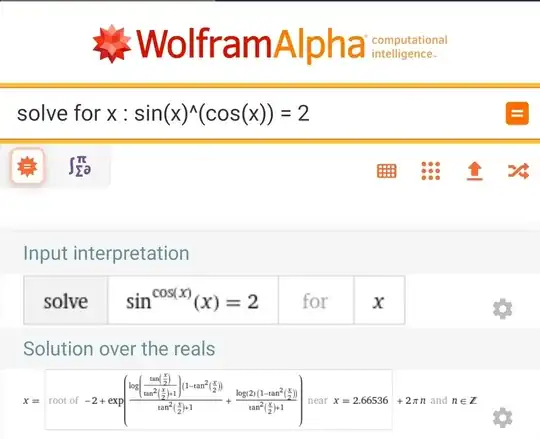
What I've found:

Can it be proved ?

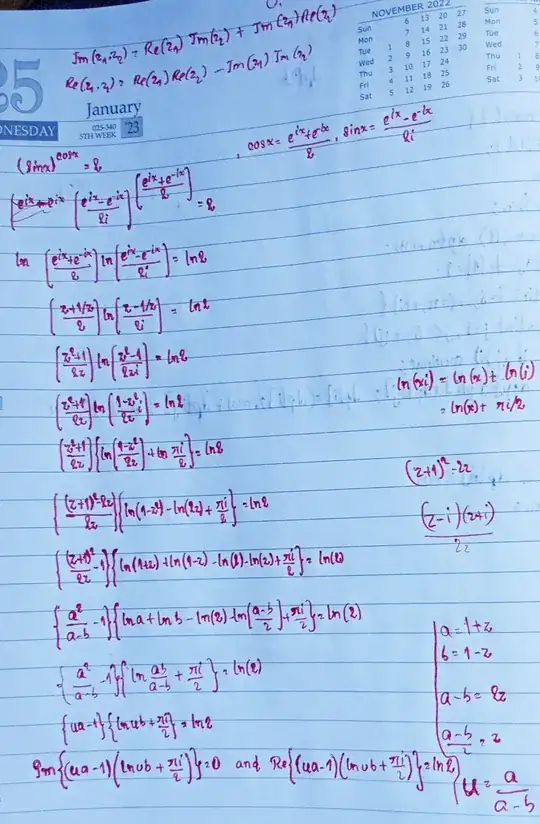
My attempt :

IV_
  • 6,964
Ash_Blanc
  • 642

2 Answers2

2

The complex solutions always diverge, from what was tried, using Lagrange reversion, but the real solutions are: $$\begin{align}\sin(x)^{\cos(x)}=2\mathop \iff^{x=\cos^{-1}(-\sqrt y)}y=1-4^{-\frac1{\sqrt y}}\implies x_k=\left(2k+\frac12\right)\pi+\sin^{-1}\left(1+\frac12\sum_{n=1}^\infty\frac{(-1)^n}{n!}\frac{d^{n-1}}{dw^{n-1}}\left.\frac{4^{-\frac{n}{\sqrt w}}}{\sqrt w}\right|_1\right),k\in\Bbb Z\end{align}$$

Expand $e^y$ as a series using factorial power $u^{(v)}$:

$$\frac{d^{n-1}}{dw^{n-1}}\left.\frac{4^{-\frac{n}{\sqrt w}}}{\sqrt w}\right|_1= \frac{d^{n-1}}{dw^{n-1}}\left.\frac{e^{-\ln(4)nw^{-\frac12}}}{\sqrt w}\right|_1=\sum_{m=0}^\infty\left(-\frac m2-\frac12\right)^{(n-1)}\frac{(-\ln(4)n)^m}{m!}$$

which expressible through the confluent Fox Wright function $_1\Psi_1$ and Fox H:

$$\frac{d^{n-1}}{dw^{n-1}}\left.\frac{4^{-\frac{n}{\sqrt w}}}{\sqrt w}\right|_1=\sum_{m=0}^\infty\frac{\Gamma\left(\frac12-\frac m2\right)(-\ln(4)n)^m}{\Gamma\left(\frac32-n-\frac m2\right)m!}=\,_1\Psi_1\left(^{\left(\frac12,-\frac12\right)}_{\left(\frac32-n,-\frac12\right)};-\ln(4)n\right)$$

The $m,n$ sums are interchangeable. Also, @Mariusz Iwaniuk reduced $_1\Psi_1$ into $_1\text F_2$ functions here. Therefore:

$$\bbox[border:2px dashed blue]{\begin{align}\sin(x)^{\cos(x)}=2\implies x_k= \left(2k+\frac12\right)\pi+\sin^{-1}\left(1+\sum_{n=1}^\infty(-1)^n\binom{\frac12}n\,_1\text F_2\left(n-\frac12;\frac12,\frac12;(\ln(2)n)^2\right)+\ln(2)\,_1\text F_2\left(n;1,\frac32;(\ln(2)n)^2\right)\right),k\in\Bbb Z\end{align}}$$

shown here:

enter image description here

Тyma Gaidash
  • 12,081
  • sure if u can solve it for real roots – Ash_Blanc May 06 '23 at 01:26
  • An integral representation like for FoxH or maybe one for $_1\Psi_1$ could give an integral representation of the real roots. – Тyma Gaidash May 06 '23 at 23:57
  • thanks a lot but i was wondering can't it have any simpler solution – Ash_Blanc May 07 '23 at 01:05
  • Can you explain how from: $$y=1-4^{-\frac1{\sqrt y}}$$ to: $$x_n=\left(2n+\frac12\right)\pi+\sin^{-1}\left(1+\frac12\sum_{n=1}^\infty\frac{(-1)^n}{n!}\frac{d^{n-1}}{dw^{n-1}}\left.\frac{4^{-\frac{n}{\sqrt w}}}{\sqrt w}\right|_1\right)$$ step by step using Lagrange reversion ? Thanks – Mariusz Iwaniuk Mar 27 '24 at 16:40
  • @MariuszIwaniuk You can use $x=a+bf(x)\implies g(x)=g(a)+\sum\limits_{n=1}^\infty\frac{b^n}{n!}\frac{d^n}{da^n}[g’(a)f(a)^n]$. Now set $a=1,b=-1,f(y)=4^{-\frac1{\sqrt y}},g(a)=\sqrt a$ $y=1-4^{-\frac1{\sqrt y}}\implies \sqrt y=1+\frac12\sum\limits_{n=1}^\infty\frac{(-1)^n}{n!}\frac{d^{n-1}}{da^{n-1}}\left.\frac{4^{-\frac{n}{\sqrt a}}}{\sqrt a}\right|_{a=1}$. Finally, use $\cos^{-1}(-x)=\frac\pi2+\sin^{-1}(x)$ and $2\pi k$ for all solutions. – Тyma Gaidash Mar 27 '24 at 17:00
  • 1
    Confluent Fox Wright function can by simplified to: (Sqrt[\[Pi]] HypergeometricPFQ[{-(1/2) + n}, {1/2, 1/2}, n^2 Log[2]^2])/ Gamma[3/2 - n] + (-1)^ n Gamma[1 + n] HypergeometricPFQ[{n}, {1, 3/2}, n^2 Log[2]^2] Log[ 4]. Thanks for explanation. – Mariusz Iwaniuk Mar 27 '24 at 17:22
  • @MariuszIwaniuk How did you simplify it? Maybe you converted to FoxH and used a command like this. Summing over $m$ in Mathematica does not evaluate. – Тyma Gaidash Mar 27 '24 at 18:15
  • 1
    Yes,I converted to FoxH and then to MeijerG. On Maple I converted MeijerG to hypergeometric function.I tried simplify more, but I failed :) – Mariusz Iwaniuk Mar 27 '24 at 21:41
  • @MariuszIwaniuk Certain Meijer G forms may only be reduced by Maple, but it is an additional software to use. If you know another way to simplify it, please the question here if you can. Thanks – Тyma Gaidash Mar 30 '24 at 23:40
1

Graphing, you more than likely saw that the first positive zero of function $$f(x)=\sin(x)^{\cos(x)} - 2$$ is, say, smaller than $\pi$.

Let $x=\pi-t$ and look for the zero of function $$g(t)= \sin(t)^{-\cos(t)} - 2$$ Using a Laurent series around $t=0$ $$g(t)=-2+\frac{1}{t}+\frac{1}{6} t \,(3 \log (t)+1)+O\left(t^3\right) \tag 1$$

So the very first estimate is $t_0=\frac 12$. Make one iteration of Newton method for $(1)$ to obtain $$t_1=\frac 12-\frac{3 \log (2)-1}{40+6 \log (2)}=0.475556\quad \implies \quad x_1=2.66604$$ while the "exact" solution is $x=2.66536$.