0

The above text is taken from the book Molecular Dynamics Simulation: Elementary Methods by J. M Haile, Pub: 1992, Page-14.

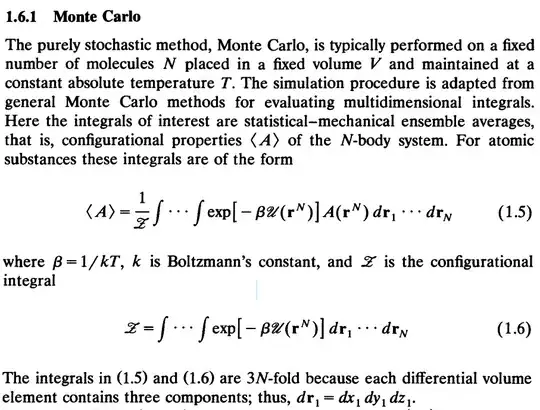
Can you translate the equation (1.5) and (1.6) into plain English?

In 2D, integration means the area between a curve and the x-axis. In 3D, it would be volume. So, how can I visualize that?

user366312
  • 1,641
  • Are you familiar with the concept of a phase space? Essentially, the position of each particle is given by $\mathbf{r}_i \in \mathbb{R}^3$, and so you're integrating over all the possible positions of each particle.

    To be honest, what counts as "plain English" depends heavily on your background. I would look into some statistical mechanics books if this terminology isn't familiar to you. In particular, try looking into "configurational integrals"

    – AlkaKadri May 12 '23 at 08:21
  • @AlkaKadri, in 2D, integration means the area between a curve and the x-axis. In 3D, it would be volume. So, how can I visualize that? – user366312 May 12 '23 at 08:33
  • Amazing. So this integral is over $3N$-dimensions, so you have a $3N$-dimensional volume. How you visualize this is an age-old pedagogical problem :)) In my experience, it's usually easiest to wrap your head around this if you visualize $N$-copies of $\mathbb{R}^3$, and so you're integrating over all possible volumes that each particle can occupy. It's hard to say much more without just starting to lecture on statistical mechanics. Would highly recommend you consult any standard book/take a course on stat mech. – AlkaKadri May 12 '23 at 08:40
  • @AlkaKadri, I understood it already. Plz, post your comments as an answer. – user366312 May 12 '23 at 08:41
  • Imagine a sphere filled with gas particles, you are integrating over all particles in that sphere. – al-Hwarizmi May 12 '23 at 08:49

1 Answers1

1

Just to reiterate what we discussed in the comments: Since the position of each particle is given by $\mathbb{r}_i \in \mathbb{R}^3$, you're essentially integrating over the entire configuration space. The "region" that you're integrating over is a $3N$-dimensional volume, but it's easiest to think of it as just $N$-copies of $\mathbb{R}^3$, each of which represents the possible positions that particle $i$ can occupy.

AlkaKadri
  • 2,130