12

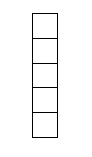
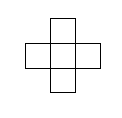
Is there a polyomino such that it can be glued to an I-shaped pentomino and to a X-shaped pentomino to obtain the same polyomino?

Or is there simple proof for non-existence of such polyomino? [Edit: See "I-shaped" and "X/(+)-shaped" pentominos below:]

enter image description here enter image description here

amWhy
  • 209,954
bleh
  • 368
  • 1
    What do you mean by "the same polyomino" ? How could it stay the same if you had stuff to it ? – Joel Cohen Jun 28 '11 at 22:42
  • 1
    oh sorry, what i wanted to say was can the polyomino obtained after gluing some polyomino to the I shaped pentomino and the polyomino obtained after gluing the same polyomino to the X shaped one be the same – bleh Jun 28 '11 at 22:51
  • I'm wondering, whether we can use the fact that, on a chess board, the I-shape covers 3 squares of one color and 2 of the opposite, whereas the cross shape splits 4+1. This won't do it by itself, because translation by a single square switches the colors, but may be we can rule out some cases? – Jyrki Lahtonen Jun 29 '11 at 09:52
  • An immediate consequence of that is that the color imbalance of the third polyomino must be 1 or 2. I don't see this leading anywhere now. – Jyrki Lahtonen Jun 29 '11 at 10:13
  • @Jyrki: that was my first take on it - in fact, I think you can say that the color imbalance must be 2, since the equations aren't quite consistent otherwise, but simple parity doesn't say anything beyond that. – Steven Stadnicki Jun 29 '11 at 21:57
  • @Jyrki: @Steven: hi,i tried the parity thing too,but without any success If such a polynomio exists,the two pentominoes,when they are glued should "add" same perimeter and interior angle to the polynomio.And since these things just depend upon the part of the polyomino where pentomino is attached (if we allow holes in polyomino,there are $2^{16}$ ways in which a I pentomino can attach to some other polynomio,and it is $2^{20}$ for X shaped one,if I am correct) ,I thought a computer program might figure out valid attachments.Can anyone help me with that,as i am novice in programming? – bleh Jun 30 '11 at 08:48
  • i am happy with a solution which may or may not involve allowing reflection – bleh Jun 30 '11 at 15:54
  • I thought about 2-colouring, but I think that the number of corners may be key. If you are allowed an overlap you can create corners in the first configuration, but without overlap you have to negotiate a difference of four between the two. This would suggest adding two to the first and removing two from the second. – Mark Bennet Jun 30 '11 at 22:34
  • In addition it will be necessary to create a string of length at least 5 in the second case, but to create a connected cross in the first looks as though it will increase this to 6. – Mark Bennet Jun 30 '11 at 22:37
  • ...(cont) Reframing it and working backwards may suggest a way to proceed, or a way to refute the possibility. – amWhy Jun 30 '11 at 23:11
  • @Steven: The colour imbalance in TonyK's solution is 1. – joriki Jul 01 '11 at 00:53
  • This page from Erich Friedman's Problem of the Month asks and answers this question for a large variety of polyomino pairs (including the requested one). – RavenclawPrefect Sep 06 '22 at 05:31

3 Answers3

16

enter image description here ${}{}{}{}{}{}{}{}{}{}{}{}{}{}$

TonyK
  • 64,559
  • Nice. Is there anything to be learned from how you arrived at this? – joriki Jul 01 '11 at 00:51
  • 3
    I arrived at it by proving its impossibility. Then I started to write up my proof here, and saw my mistake. – TonyK Jul 01 '11 at 00:53
  • 3
    Specifically, I knew that the glued-together polyomino must have a column of five squares on the left, and a column of a single square on the right (or vice versa). I thought this led to a contradiction, but it turned out to lead to the solution. – TonyK Jul 01 '11 at 00:55
6

This isn't a real answer, but if you allow "infinite polyominos" then you can do it. Consider the following "infinite polyomino", without the yellow included:

infinite poly

Then adding a either "+" or an "I" pentomino where indicated in yellow will give you the same result up to translation. In fact, you can add on $n$ "+" pentominos or $n$ "I" pentominos to this so that they'll give you the same answer, for any $n \in \mathbb{Z}$. (Yes $\mathbb{Z}$, as long as you consider "adding a negative pentomino" to mean what I think it should mean :) )

A similar construction works for any pair of finite polyominos.

3

By gluing, if you allow overlapping of a square: e.g. the top square of an "I" shaped "tri-omino" could be glued to the bottom square of the "+" pentomino (vertically aligned), while its center square (of I tri-omino) could be glued orthogonally to the 2nd square from the top of the I pentomino.) This would result in a matching 7-ominos (heptominos). (See my (pitiful) LaTeX attempt at constructing the figure I'm alluding to - just pretend there are no gaps vertically!).

If overlapping is not allowed, (i.e. gluing must occur from edge to edge of each respective polyomino, then I'm doubting the existence of a polyomino which can be attached to each separate figure with the result a match. But I've no proof, yet.

$\quad\square$
$\square\square\square$
$\quad\square$
$\quad\square$
$\quad\square$

amWhy
  • 209,954
  • The heptomino was all I could think of, too. – Jack Henahan Jun 29 '11 at 01:36
  • 4
    hi,thnx for the answer,but this puzzle is trivial if overlapping is allowed as we can glue a very large polyomino to the top of any pentomino to obtain the same large polyomino! – bleh Jun 29 '11 at 06:37
  • I suppose that putting the polyominoes on a cylinder of girth 3 (or other changes in the topology) would also amount to bending the rules :-) – Jyrki Lahtonen Jun 29 '11 at 18:14