Yes, $=$ is being used to denote "is homeomorphic to", which is a (slight) abuse of notation; really the notation $\cong$ should be used, but it's not a big deal here.
Intuitively, I find the fact $D^{n+1}/S^n\cong S^{n+1}$ to be quite clear. As usual in math, we may not be able to see large numbers of dimensions, but we can get a good intuition from the dimensions we can visualize. Certainly, collapsing $S^0$ (the points $1$ and $-1$) in $D^1=[-1,1]$ produces a circle. And here is a nice visualization for $n=1$:
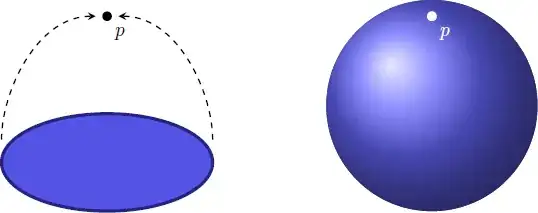
It should be clear that, in general, collapsing the "edge" of a disk to a point, and leaving everything else the same, "closes up" the disk into a sphere of the next highest dimension.
\documentclass{standalone}
\usepackage{tikz}
\tikzstyle{mypoint}=[inner sep=0pt,outer sep=0pt,minimum size=5pt,fill,circle]
\colorlet{blue1}{blue!90!white}
\colorlet{blue2}{blue1!80}

\begin{document}
\begin{tikzpicture}[scale=1.5]
\node[mypoint] [label=285:$p$]  at (0,1.1) {};
\fill[color=blue2!80!gray] (0,-0.7) ellipse (1.3 and 0.6);
\draw[color=blue2!50!black,ultra thick] (0,-0.7) ellipse (1.3 and 0.6);
\begin{scope}[dashed,thick,->,shorten >=6pt,shorten =stealth]
\path (-1.3,-0.7) edge[out=90,in=180] (0,1.1);
\path (1.3,-0.7)  edge[out=90,in=0]   (0,1.1);
\end{scope}

\fill[ball color=blue!60] (4,0) circle (1.3);
\node[mypoint,white] [label={[white]285:$p$}] at (4,1.1) {};
\end{tikzpicture}
\end{document}


