This is a follow up question to my earlier question here. I am reading the same document, namely the one by Brian Osserman available here. Now in the document he has stated the Valuative Criteria for Separatedness:
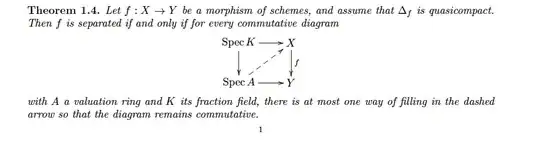
Now I am trying to understand the only if part of the statement, namely that if $f$ is separatedness then there is at most one way of filling in the dashed arrow. So assume that there were two arrows $g_1,g_2 : \operatorname{Spec} A \to X$ making the diagram above commute. This gives rise to a map $g : \operatorname{Spec} A \to X \times_Y X$. If $\iota$ denotes the canonical map $\iota: \operatorname{Spec} K \to \operatorname{Spec} A$, we thus get a map $g \circ \iota$ whch must factor through the diagonal morphism $\Delta_f$.
My questions are:
<ol>
<li><p>I know that $\Delta_f$ is a closed immersion by assumption but why does this mean that $g(\operatorname{Spec} A) \subseteq \Delta_f(X)$?</p></li>
<li><p>Also, I know that $\operatorname{Spec} A$ is reduced, but why does this mean $g$ factors through $X$?</p></li>
<li><p>How can I conclude from here that $g_1 = g_2$?</p></li>
</ol>

