3

let $f(x)$ show that $$f(x)\approx\sum_{i=0}^{2n-1}f(t_{j})L_{j}(t)$$

where $$t_{j}=\dfrac{\pi}{n}j$$ $$L_{j}(t)=\dfrac{1}{2n}\left[1+2\displaystyle\sum_{m=1}^{n-1}\cos{m(t-t_{j})}+\cos{n(t-t_{j})}\right], j=0,1,2,\cdots,2n-1$$

It is say that “Trigonometric interpolation”,But I find sometimes, I can't find this and can't anywhere have solution,But this is from china book,I think this have solution,Have you someone can help me,Thank you very much.

is from:enter image description here
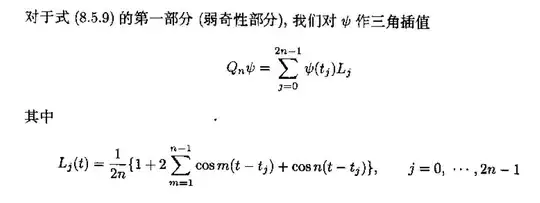
and the background is this:Howuse this $R_{l}=\frac{1}{n}\left(\frac{(-1)^l}{2n}+\sum\limits_{m=1}^{n-1}\frac{1}{m}\cos{\frac{ml\pi}{n}}\right)$ and MATLAB get this four fig?

math110
  • 93,304

1 Answers1

1

This is based on the Discrete Fourier Transform for a function on the sample points $t_j$ for $j\in\{0, \ldots, 2n-1\}$. Let $e_m(t_j) = \exp(imt_j)$ for $m\in \mathbb{Z}$. Note that $e_{m+2n}=e_m$ on the sample points $t_j$. For a function $f$ the DFT $\hat{f}$ is then expressed by

$$\hat{f}(m) = \sum_{j=0}^{2n-1} f(t_j) e_{-m}(t_j)$$

and the inversion is given by

$$\begin{eqnarray} 2n f(t_k) &=& \sum_{m=0}^{2n-1}\hat{f}(m)e_m(t_k)\\ &=& \sum_{j=0}^{2n-1}f(t_j)\sum_{m=0}^{2n-1}e_{-m}(t_j)e_m(t_k)\\ &=& \sum_{j=0}^{2n-1}f(t_j)\sum_{m=0}^{2n-1}e_m(t_k-t_j)\\ &=& \sum_{j=0}^{2n-1}f(t_j)\left(1+\cos n(t_k-t_j) + \sum_{m=1}^{n-1}e_m(t_k-t_j) + \sum_{m=1}^{n-1}e_{2n - m}(t_k-t_j)\right)\\ &=& \sum_{j=0}^{2n-1}f(t_j)\left(1+\cos n(t_k-t_j) + 2\sum_{m=1}^{n-1}\cos m(t_k-t_j)\right) \end{eqnarray}$$

The interpolation simply replaces $t_k$ by an arbitrary $x$ to get a periodic real function with period $2\pi$. This interpolation uses the low frequency information from the sampled signal.

WimC
  • 32,192
  • 2
  • 48
  • 88