While reading an old book, I came across this theorem:
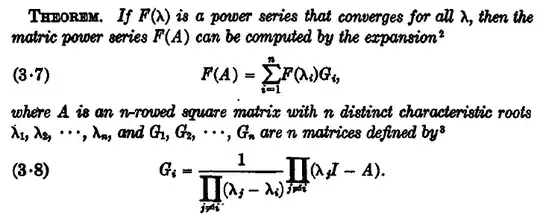
Neither name nor proof was given, can somebody provide some further information about this throrem? Thanks.
While reading an old book, I came across this theorem:
Neither name nor proof was given, can somebody provide some further information about this throrem? Thanks.

This formula is known as Sylvester's formula in the matrix theory literature.

Let $P$ be the characteristic polynomial of $A$. Divide $F$ by $P$ to get $$F=PQ+R$$
where $R$ is a polynomial of degree smaller than that of $P$. By Hamilton-Cayley $P(A)=0$. Then $$F(A)=R(A).$$
All we need is to compute $R$. But we also have that $P(\lambda_i)=0$ for the $n$ different eigenvalues $\lambda_i$. Therefore $R(\lambda_i)=F(\lambda_i)$. Using lagrange interpolation we get that $$R(x)=\sum_{i=1}^{n}F(\lambda_i)G_i(x),$$
where $$G_i(x)=\frac{1}{\prod_{j\neq i}(\lambda_j-\lambda_i)}\prod_{j\neq i}(\lambda_j-x).$$ Evaluating in $A$ the formula for $R$ you get the formula for $F(A)$.
