4

I am building a stool with cross-braced legs and I am trying to figure out how to properly compute the size of the sides. I made the schema below:

  • ABCD is a rectangle of length L and width l;
  • the inner shape is the leg, so GH is parallel to EF;
  • w is the width of the leg.

I am looking for a and b such as: BG = BE = b and DH = 2xDF = 2a.

stool leg drawing

My intuition is that for a given L, l and w, there should a unique a and b that satisfy the constraints. I first tried to calculate the area of ABCD in two ways:

  1. A_1 = L.l
  2. A_2 = sum of the area of all the inner right triangles and rectangle.

Then solve for A_1 = A_2. But A_2 becomes rapidly quite hairy so I don't think it is the right approach. Any suggestion?

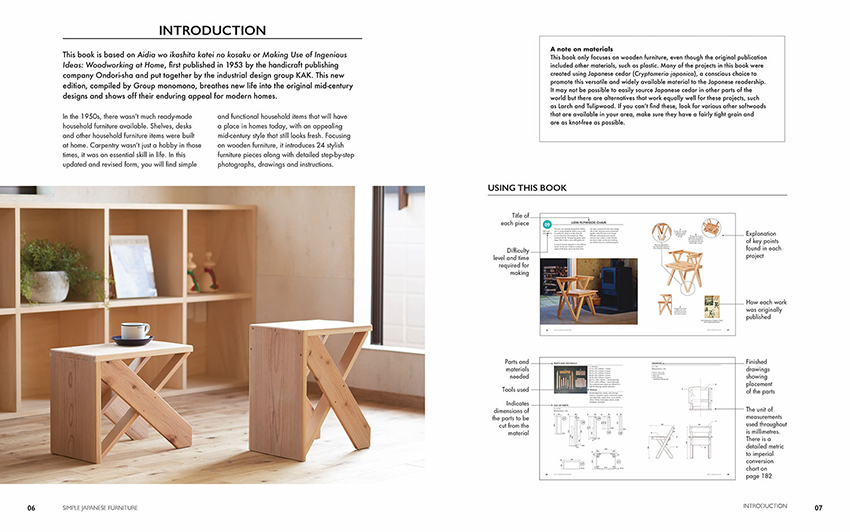
PS: for those curious about the stool, you can see it on this picture.

bill0ute
  • 143
  • 1
    So nice question! Do you know about trigonometry? – ajotatxe Jan 26 '24 at 22:36
  • I have vague memories of the cos/sin in a right triangle. Is that what you are refering to @ajotatxe? I only tried to solve this using Pythagorean without success so far. – bill0ute Jan 26 '24 at 23:02

3 Answers3

3

There are three relationships that must be satisfied. The first condition is that $\triangle FAE \sim \triangle GCH$. This implies $AF \cdot CH = AE \cdot CG$, or $$(\ell - a)(L - 2a) = (\ell - b)(L - b). \tag{1}$$ The second is a Pythagorean relationship, namely $$\begin{align} CH^2 + CG^2 &= (HJ + JG)^2 \\ &= \left(HJ + \sqrt{EG^2 - EJ^2}\right)^2 \\ &= \left(HJ + \sqrt{EB^2 + BG^2 - EJ^2}\right)^2, \end{align}$$ and if we denote $d = HJ = IE$, this becomes $$(L - 2a)^2 + (\ell - b)^2 = \left(d + \sqrt{2b^2 - w^2}\right)^2. \tag{2}$$ Similarly, the final relationship arises from right $\triangle FAE$: $$(\ell - a)^2 + (L - b)^2 = \left(d + \sqrt{5a^2 - w^2}\right)^2. \tag{3}$$ Taken together, $(1)$-$(3)$ is a system of three equations in the unknowns $a, b, d$, given the dimensions $L, \ell, w$. However, their solution is not straightforward. It leads to a high-degree polynomial in $a$ and $b$ that does not appear to have a simple closed-form solution. As such, a numerical method may be required. For instance, $L = 17$, $\ell = 9$, and $w = 1$ yields the approximate solution $a \approx 0.552646$, $b \approx 0.741606$.

heropup
  • 135,869
  • thanks, it's indeed more complex than I thought. Can you please expand on the implication that gives equation (1)? Also, in equation (3), isn't the first term squared? Does that give a better solution? – bill0ute Jan 27 '24 at 10:09
  • 1
    @bill0ute The first implication is that the two triangles must be similar, because they are both right triangles, and $\angle CHG$ is congruent to $\angle AEF$ since $CH || AE$ and $GH || FE$. So corresponding parts of similar triangles are in proportion, e.g. $AF/CG = AE/CH$. As for the lack of a square in the first term of $(3)$, that was a typographical error that has now been corrected. – heropup Jan 27 '24 at 18:55
2

The stool leg is bounded between two parallel lines that are separated by $w$. If $m$ is the slope of these lines ($m$ is negative), then

$ y = m x + K_1 $

Substitute the point $(L , b)$, this will give

$K_1 = b - m L $

For the bottom line, its equation is

$ y = m x + K_2 $

Substitute $(L - b , 0 )$. This will give

$ K_2 = m (b - L ) $

The distance between the two lines is $w$, so

$ w = \dfrac{ - m L + b - m (b - L) }{ \sqrt{1 + m^2} } = \dfrac{ b (1 - m) } { \sqrt{1 + m^2} }$

Note the the slope is related to $L, H, a, b $ as follows

$ m = \dfrac{ b - H }{L - 2 a} = \dfrac{ a - H }{ L - b } $

These are actually two equations:

$ m (L - 2 a) = b - H $

and

$ (b - H) (L - b) = (L - 2 a)(a - H) $

These two equations are quadratic in $a, b, m $, however the first, when squared to remove the square root becomes

$ w^2 (1 + m^2) = b^2 (1 - m)^2 = b^2 (1 - 2 m + m^2 ) = b^2 - 2 b (bm) + (bm)^2 $

we need to get rid of the $(mb)$ term, and for that, note that

$ m = \dfrac{ a - H }{ L - b } $

Therefore,

$ m L - m b = a - H $

i.e.

$ m b = m L - a + H $

Substitute this, you get

$ w^2 (1 + m^2) = b^2 - 2 b ( m L - a + H ) + (m L - a + H)^2 $

Now it is quadratic.

You can solve these equations using Mathematica Online, or using SAGE

I solved using This SAGE worksheet, where $L, H, w$ are as in the example given by heropup, i.e. $L = 17$ , $ H = 9 $ and $ w = 1$. As is shown on the worksheet, the only valid solution is $ a = 0.552646 $ and $ b = 0.741606 $ and $ m = -0.51957 $.

As another example, suppose $L = 10, H = 20, w = 4$, then the solution is $a = 1.798091, b = 3.102028, m = -2.63873 $

Hosam Hajeer
  • 21,978
  • To sumarize, you obtain the first equation by using the distance between two parallel lines and the other two as they have the same slope? – bill0ute Jan 30 '24 at 10:11
  • Yes. That's exactly how you obtain the equations. – Hosam Hajeer Jan 30 '24 at 10:39
  • Ok nice, also I was wondering, why do you need to get rid of the (mb) term? – bill0ute Jan 30 '24 at 11:37
  • You don't need that if you're going to solve with Mathematica or SAGE. But in my own program that I've written to solve three equations in three variables, the three equations have to be quadratic. And that's why I had to get to rid of $(mb)^2$ which is quartic. – Hosam Hajeer Jan 30 '24 at 11:51
  • Makes sense. The problem looked rather simple to me initially, I thought I would solve it with Pythagoras. Any intuition why it requires more calculation than it looks? Would have it been simpler if the leg was exactly diagonal, so replacing (a, 2a) with (b, b)? – bill0ute Jan 30 '24 at 13:39
  • Yes. Definitely. That would make it much simpler. – Hosam Hajeer Jan 30 '24 at 14:59
0

With Analytic Geometry.

Calling

$$ \cases{ p_1 = (0,h-a)\\ p_2 = (L-b,0)\\ q_1 = (2a,h)\\ q_2 = (L,b) } $$

we have two lines

$$ \cases{ L_1\to p = p_1 + \lambda_1 \vec v_1\\ L_2\to q = q_1 + \lambda_q \vec v_2\\ \vec v_1 = \frac{p_2-p_1}{\|p_2-p_1\|}\\ \vec v_2 = \frac{q_2-q_1}{\|q_2-q_1\|}\\ } $$

and as $L_1$ and $L_2$ are parallel, we have:

$$ \cases{ \vec v_1\times\vec v_2 = \vec 0\\ (p_1-q_1)\cdot \vec v_1^{\top} = w \ \ \text{where}\ \ \ \vec v_1^{\top}\ne \vec 0,\ \ \ \vec v_1^{\top}\cdot\vec v_1 = 0\\ } $$

Now, as

$$ \cases{ \vec v_1 = \frac{1}{\sqrt{(h-a)^2+(L-b)^2}}(L-b, a-h)\\ \vec v_2 = \frac{1}{\sqrt{(h-b)^2+(L-2a)^2}}(L-2a,b-h) } $$

then

$$ \cases{ \vec v_1\times \vec v_2 = \vec 0\Rightarrow 2 a^2-a (2 h+L)+b (L-b+h)=0\\ (p_1-q_1)\cdot \vec v_1^{\top} = w\Rightarrow \frac{a (2 a+b-2 h-L)}{\sqrt{(h-a)^2+(L-b)^2}}+w=0 } $$

so we have to solve for $\{a,b\}$

$$ \cases{ 2 a^2-a (L+2 h)+b (L-b+h)=0\\ \frac{a (2 a+b-2 h-L)}{\sqrt{(h-a)^2+(L-b)^2}}+w=0 } $$

Cesareo
  • 33,252