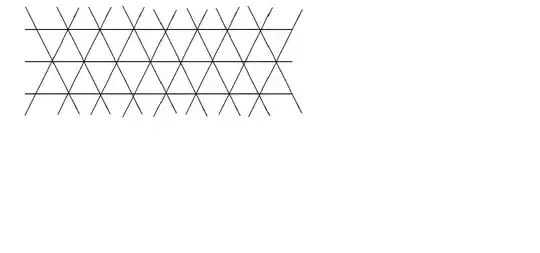
The answer hinges on the intended interpretation of average number of laddoos per mouse. Let $M$ be the set of mice and $L$ the set of laddoos. Obviously $M$ and $L$ are countably infinite, so there is a bijection between them, and one could use it to argue that the ratio is $1$. However, there are also $2$-$1$ and $3$-$1$ maps from $M$ to $L$, which one could use to argue for ratios of $2$ and $3$, respectively, and there are also $2$-$1$ and $3$-$1$ maps from $L$ to $M$, which one could use to argue for ratios of $\frac12$ and $\frac13$, respectively. It seems clear, then that this approach is not the intended one.
Assuming that the geometrical aspects of the problem are not a red herring, we should probably be looking at a limit of the true ratio as we look at larger and larger parts of the grid. Of course we can gerrymander the sections to get all sorts of strange results, so we need to be a bit more precise. A natural choice is to pick a point as origin, let $D_r$ be the disk of radius $r$ centred at that origin, and say that the ratio is
$$\lim_{r\to\infty}\frac{|L\cap D_r|}{|M\cap D_r|}\;.$$
For origin we might take one of the vertices, and as a first approximation to disks we might look at hexagonal regions with sides of length $1$, length $2$, and so on. If we go out to the hexagon with sides of length $n$, we get a hexagonal region encompassing $$1+\sum_{k=1}^n6k=1+3n(n+1)=3n^2+3n+1$$ vertices and $$6\sum_{k=1}^n(2k-1)=6n^2$$ unit triangles. Clearly
$$\lim_{n\to\infty}\frac{3n^2+3n+1}{6n^2}=\frac12\;.$$
A more intuitive way to see this is to imagine that each laddoo is shaped like a small pancake and sits with its centre right at its vertex, with $\frac16$ of itself extending into each of the six neighboring triangles. If each mouse now eats every bit of laddoo that it can find in its trangle, the laddoos completely disappear, and each mouse has eaten $3\cdot\frac16=\frac12$ of a laddoo. Since each mouse is eating only the nearest laddoo parts, this procedure should respect the geometry, and indeed we see that it does, since it produces the same result as the more detailed calculation.