The question Equation 1 (is repeated here to easier reference) is:
$$
\left(2 n \right)^{\log 2} = \left( 5 n \right)^{\log 5}
\tag{Eq. 1}$$
Then,
$$\begin{align*}
\left(2 \right)^{\log 2}\left(n \right)^{\log 2} &= \left( 5 \right)^{\log 5} \left( n \right)^{\log 5}
\tag{Eq. 2}\\
\frac{\left(n \right)^{\log 2}}{ \left( n \right)^{\log 5}}
&=
\frac{\left( 5 \right)^{\log 5}} { \left(2 \right)^{\log 2}}
\tag{Eq. 3}\\
n^{\log 2-\log 5 }
&=
\frac{\displaystyle \left( 5 \right)^{\log 5}}
{\displaystyle \left(2 \right)^{\log 2}}
\tag{Eq. 4}
\end{align*}$$
Finally, the result is given in Equation 5 as:
$$
\boxed{
n =
\left(
\frac{\displaystyle \left( 5 \right)^{\log 5}} { \displaystyle \left(2 \right)^{\log 2}}
\right)
^{
\frac{\displaystyle 1}
{ \displaystyle \log 2 - \log 5 }
} = \frac{1}{10}
}\tag{Eq. 5a}$$
Also, since all of the symbolic algebraic operation was independent of the base $\log_b$, the same result holds independent of base $b$ so long that $b>0$ and $b \ne 1$ (with algebraic steps referenced in this link):
$$
\boxed{
n =
\left(
\frac{\displaystyle \left( 5 \right)^{\log_b 5}} { \displaystyle \left(2 \right)^{\log_b 2}}
\right)
^{
\frac{\displaystyle 1}
{ \displaystyle \log_b 2 - \log_b 5 }
} = \frac{1}{10}
}\tag{Eq. 5b}$$
Simplification of Equation 5 to Get to $n=\frac{1}{10}$
From Equation 5, it can be rewritten as follows:
$$
n=\left(\frac{\displaystyle 1 }
{\displaystyle (2)^{\log 2} (5)^{-\log 5}}
\right)^
\left(\frac{\displaystyle 1}{\displaystyle \log 2-\log 5}
\right)
$$
$$
n=
\left(
\left(\frac{\displaystyle 1 }
{\displaystyle (2)^{\log 5} (5)^{-\log 2}}
\right)^
\left(\frac{\displaystyle 1}{\displaystyle \log 2-\log 5}
\right)
\right)
\left(\frac{\displaystyle 1 }
{\displaystyle (2*5)^{\log 2 -\log 5}}
\right)^
\left(\frac{\displaystyle 1}{\displaystyle \log 2-\log 5}
\right)$$
$$
\tag{Eq. 6}
$$
For the professionals, the symbolic representation of $0.1$ is sufficient to be derived using standard symbolic math manipulation techniques. Especially the identities "$a^n*b^n=(a*b)^n$" , "$(a^n)^{\frac{1}{n}}=a$" for "$a \ge 0$", and
$a^{\left(\log b \right)} = b^{\left(\log a \right)}$ are helpful in the above simplifications.
In particular, the simplifications and Equations 6 together with the identity $a^{\left(\log b\right)} = b^{\left(\log a \right)}$ imply that
$$
\left(\frac{\displaystyle (5)^{\log 2} }
{\displaystyle (2)^{\log 5}}
\right)^
\left(\frac{\displaystyle 1}{\displaystyle \log 2-\log 5}
\right)
=\left({\displaystyle 1 }\right)^
\left(\frac{\displaystyle 1}{\displaystyle \log 2-\log 5}
\right)=1
\tag{Eqs. 7}$$
$$
n=\left({\displaystyle 1 }\right)
\left(\frac{\displaystyle 1 }
{\displaystyle (2*5)^{\log 2 -\log 5}}
\right)^
\left(\frac{\displaystyle 1}{\displaystyle \log 2-\log 5}
\right)
\tag{Eq. 8}
$$
And finally, referencing the identity $\left(a^n\right)^{\frac{1}{n}}=a$ for $a>0$ and $n \ne 0$, Equation 8 leads to the desired solution.
Also, more step-to-step simplification steps are given this reference, "Algebraically Simplify $n =\left( \frac{ \left(5\right)^{\log 5}} { \left(2 \right)^{\log 2}} \right) ^{ \frac{1} {\log 2-\log 5 } } = \frac{1}{10}\text{"}$.
With both either reference link or use of the identity $\left(a^n\right)^{\frac{1}{n}}=a$ options, immediately the decimal simplification and answer from Equation 8 becomes apparent:
$$
\boxed{
n=
\left({\displaystyle 1}\right)
\left( \frac{\displaystyle 1} {\displaystyle 2} \right)
\left( \frac{\displaystyle 1} {\displaystyle 5} \right)
=\frac{\displaystyle 1}{\displaystyle 10}
}
\tag{Eqs. 9}$$
Symbolic to Decimal Verification
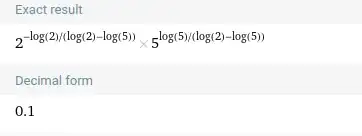
This result can also easily be verified with a scientific calculator (done already below), so it is definitely correct:
 Also with the Wolfram Online Symbolic Calculator:
 The decimal result is the same, that $n=0.1$:


$$\large (\color{#c00}{e^{\large -(\ell_2^2-\ell_5^2)}})^{\Large \frac{1}{\ell_2-\ell_5}}! =:! e^{\large -(\ell_2+\ell_5)}= 2^{-1}5^{-1}\qquad\qquad$$
– Bill Dubuque Mar 07 '24 at 17:45