3

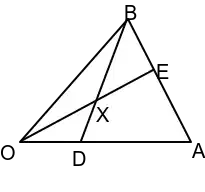
Diagram

Point $A$ and $B$ have position vectors $\vec a$ and $\vec b$ respectively relative to an orgin $O$.

The point $D$ is such that $\overrightarrow{OD} = k\overrightarrow{OA}$ and the point $E$ is such that $\overrightarrow{AE} = l\overrightarrow{AB}$.

The line segments $BD$ and $OE$ intersect at $X$.

If $\overrightarrow{OX} = \frac{2}{5}\overrightarrow{OE}$ and $\overrightarrow{XB} = \dfrac{4}{5}\overrightarrow{DB}$.

Express $\overrightarrow{OX}$ and $XB$ in terms of $\vec a, \vec b, k, l$ and hence evaluate $k$ and $l$.

I have worked out most of the problem but can't figure out how to evaluate $l$.

Using ratio theorem, I got $\overrightarrow{OX}$ as,

$$ \overrightarrow{OX} = \dfrac{2}{5}\Big[(1-l)a + lb\Big] $$

And similarly, $\overrightarrow{XB}$

$$ \overrightarrow{XB} = \dfrac{4}{5}(b - ka) $$

Then using, $$ \begin{align} \overrightarrow{OX} + \overrightarrow{XB} &= \overrightarrow{OB} \\ \dfrac{2}{5}\Big[(1-l)a + lb\Big] + \dfrac{4}{5}(b - ka) &= b\\ \\ \text{...}\\ \\ [2(1-l) - 4k]a &= (1-2l)b\\ 2(1-l)- 4k &= 1 - 2l & \text{(a and b are non-zero and non-parallel)}\\ -4k &= -1 \\ k &= \dfrac{1}{4}\\ \end{align} $$

I can't seem to figure out how to get $l$. I tried $\overrightarrow{DA} + \overrightarrow{AE} + \overrightarrow{E} = \overrightarrow{DX}$ and $\overrightarrow{OA} + \overrightarrow{AE} = \overrightarrow{OE}$, these just give an equality statement.

How do I evaluate $l$?

Thanks for your help.

mathguy80
  • 1,321

1 Answers1

1

At some point you said $$ 2(1-\ell)- 4k = 1-2 \ell $$ But you should've noticed that you could say that because $$ 2(1-\ell) - 4k = 0 = 1-2 \ell. $$ I think that gives you $\ell = 1/2$.

Hope that helps,

  • Thanks. Can you please clarify why you equated it to 0? – mathguy80 Jul 20 '11 at 15:05
  • Well, since you have a multiple of $a$ and a multiple of $b$ that are equal, and that those two vectors are not colinear, it must be because they are both the zero vectors, hence their coefficients are both zero. Isn't that why you said that $2(1-\ell) - 4k = 1-2\ell$ in the first place? – Patrick Da Silva Jul 20 '11 at 15:19
  • The proof that I was taught is, $$ $$ Let $a$ and $b$ be two non-zero and non-parallel vectors. If $$\alpha a + \beta b = \lambda a + \mu b$$ for some $\alpha, \beta, \lambda, \mu \in \mathbb{R}$, then $$(\alpha - \lambda)a = (\mu - \beta)b$$ and hence, $$\alpha = \lambda \text{ and } \mu = \beta$$.

    It was assumed that a and b are not zero vectors. Does that hold for zero vectors also?

    – mathguy80 Jul 20 '11 at 16:06
  • It does not, indeed. Having $(1-2) \vec{0} = \vec 0$ does not imply $1=2$. =) But the idea in your proof was that since $a$ and $b$ cannot be parallel, it is impossible for them that a multiple of $a$ is equal to a multiple of $b$, unless they are both $0$, which leads to both coefficients being $0$. – Patrick Da Silva Jul 20 '11 at 16:15
  • Ah! Thanks, that makes sense. I was beginning to think I had learned some basic ideas incorrectly! – mathguy80 Jul 21 '11 at 02:51
  • By the way, what doesn't work if $a$ and $b$ are parallel is pretty much the same : saying that they're parallel is that one is a multiple of the other, so that $\lambda_1 \vec a$ is the first vector and $\lambda_2 \vec a$ is the second vector. Supposing $\alpha (\lambda_1 \vec a) = \beta (\lambda_2 \vec a)$ means $(\alpha \lambda_1 - \beta \lambda_2) \vec a = 0$, which means $\alpha \lambda_1 - \beta \lambda_2 = 0$ if $\vec a$ is non-zero, and means nothing if $\vec a = 0$. Clearly you cannot deduce $\alpha = \beta$ in this case either. – Patrick Da Silva Jul 22 '11 at 22:11
  • Thanks again for your help! It really helped me understand this better. – mathguy80 Jul 23 '11 at 03:54