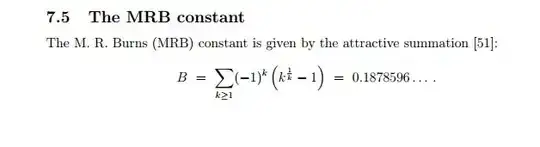
The first equality can be reproduced by formally stating the double sum: write down the expanded exponantial series for each term in one row, sum then column-wise to get the derivatives of the $\eta()$ and sum then the $\eta()$-expressions. Here the $\eta(s)$ is the alternating $\zeta(s)$ and $\eta^{(m)}(s)$ the $m$'th derivative.
$$ \begin{array} {rclll}
-\exp( {\log(1) \over 1})+1 & = & -{\log(1) \over 1}
&-{\log(1)^2 \over 1^2 2!}
&-{\log(1)^3 \over 1^3 3!} & - \cdots \\
+\exp( {\log(2) \over 2})-1 & = &+{\log(2) \over 2}
&+{\log(2)^2 \over 2^2 2!}
&+{\log(2)^3 \over 2^3 3!} & + \cdots \\
-\exp( {\log(3) \over 3})+1 & = &-{\log(3) \over 3}
&-{\log(3)^2 \over 3^2 2!}
&-{\log(3)^3 \over 3^3 3!} & - \cdots \\
\vdots \qquad & \vdots & \quad\vdots & \quad\vdots& \quad\vdots
& \ddots \\
\hline \\
B \qquad & = & {\eta^{(1)}(1) \over 1!}
&- {\eta^{(2)}(2) \over 2!}
&+ {\eta^{(3)}(3) \over 3!} & - \cdots
\end{array}$$
I've not yet the expansion into the formula with the derivatives of $\eta()$ at zero; perhaps I can supply that tomorrow.
Numerical check
In Pari/GP I get for the original sum
$$ B = \sum_{k=1}^\infty (-1)^k( \exp( \log(k)/k)-1)$$
B=sumalt(k=1,(-1)^k * (exp( log(k)/k) -1)
well converging the value
B=0.187859642462067120248517934054273230055903094900138786172005...
as well for
B = -sum(k=1,6,(-1)^k*aetad(k,k)/k!)
(but to fewer digits).
My user-defined function aetad(s,d) gives the d'th derivative of $\eta()$ at $s$ and I implemented that aeta() using the $\eta()$ / $\zeta()$ conversion formula
              aeta(s) = if(s==1,return(log(2));return( (1-2/2^s)*zeta(s)  )
              {aetad(s=1,d=0)=local(h1=1e-12,z);
                      z= sum(k=0,d,  (-1)^k*binomial(d,k)*aeta(s +(d/2-k)*h1));
                         return( z/h1^d); }
I have also another implementation of the $\eta()$ and its derivatives which allows to access higher derivatives (in the above version the 10'th or even 20'th derivative were impractical). This version is also independent of the software-included zeta-function but uses Pari/GP's
sumalt() procedure which allows to evaluate alternating (moderately) divergent series. My approach computes the taylor-expansion for the $\eta()$ function by default centered around zero but can easily be generalized to any center:
fmt(200,12)  \\ user defined; set internal precision to 200 digits, display to 12 digits
default(seriesexpansion,24)          \\ set expansion-limit for power series
m_coeffs = vectorv(24);              \\ vector for 24 aeta-taylor-series
{for(m=0,23,
    tay_aeta = sumalt(k=0,(-1)^k/(1+k)^(x+m));  \\ taylorseries for aeta around m
    m_coeffs[1+m]= polcoeffs(tay_aeta,24);      \\ store leading 24 taylorcoefficients
   );
  m_coeffs = Mat(m_coeffs);}        \\ make a matrix from the list of taylor series
After that, the desired coefficients (the derivatives of the $\eta(m)$ ) nicely divided by the factorials, occur on the diagonal of the coefficients-matrix, and we only need sum them with alternating sign:
   B = sum (k=1,23, -(-1)^k*m_coeffs[1+k,1+k])
   \\ 0.1878596424620671202485179340542732... the leading correct digits
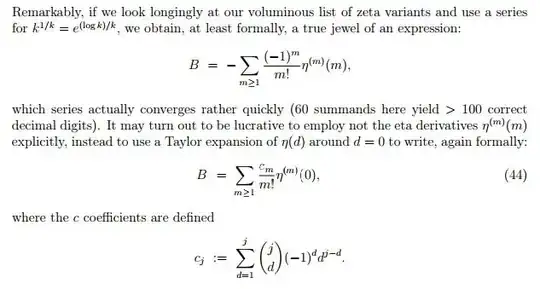 Here is how I worked formula 44 and got -B:

