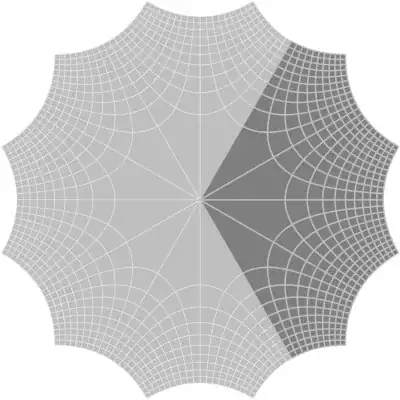
$\newcommand{\Reals}{\mathbf{R}}$OP appears to be gone, but for posterity:
The plane $\Reals^{2}$ has at least two structures that are relevant:
- The Euclidean plane (in fancy terms a Riemannian manifold) with its concepts of distance and angle;
- The complex plane (in fancy terms, a Riemann surface, or holomorphic curve) with its concepts of orientation and angle.
The Euclidean Plane: The cone acquires a flat (Gaussian curvature zero) metric away from the vertex $V$. The Riemannian universal cover of the cone with the vertex removed acquires an incomplete flat metric isometric to a doubly-infinite sequence of punctured Euclidean planes, each copy slit along a ray from the origin to infinity, and with the upper edge of the slit in each copy joined to the lower edge of the "next" copy. Alternatively, the Riemannian universal cover may be viewed as an incomplete flat metric on the open half-plane $(0, \infty) \times \Reals$, namely as the pullback of the flat metric on the punctured plane by the mapping $(r, \theta) \mapsto (r\cos\theta, r\sin\theta)$.
Singularity of the vertex: Here are a couple of equivalent phenomena, detailed in Paper Surface Geometry:
- If $C$ is a simple closed path enclosing the vertex, parallel transport around $C$ is not the identity, but clockwise rotation by $2\pi/n$ (first diagram).
- The incident angle at the vertex $V$ is $2\pi/n \neq 2\pi$. Consequently, the total interior angle of a triangle enclosing $V$ is $3\pi - 2\pi/n = \pi + 2\pi(n - 1)/n > \pi$ (second diagram). Qualitatively, the Gaussian curvature at the vertex is infinite, but the integral of the Gaussian curvature over a neighborhood of the origin has the well-defined finite value $2\pi(n - 1)/n$.
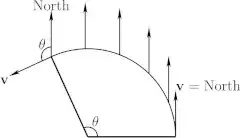
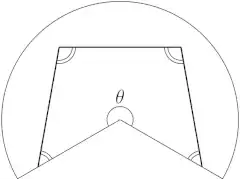
Lifting paths: A path on the cone not passing through $V$ can be lifted (uniquely given a starting point) by standard properties of covering spaces. The continuous extension of the covering map to the closed Euclidean half-plane sends the entire $\theta$-axis to the vertex, however. The prospects for uniquely lifting a path starting at $V$ are therefore problematic. For example:
- The mapping $\theta = 1/r$ for $0 < r \leq 1$ extended arbitrarily to $r = 0$ descends to a continuous path on the cone, but this path has no continuous lift.
- A constant path at $V$ has uncountably many lifts with specified starting point.
The Complex Plane: The quotient may be effected by the $n$th power mapping $z \mapsto z^{n}$. The holomorphic quotient is the complex plane, which is blissfully unaware of the branching at $0$, i.e., is smooth everywhere. The case $n = 3$ is shown. The darker-shaded wedge is a fundamental domain; preimages of a Cartesian grid in each fundamental domain are shown.